Back to Search

Gulfstar 44

Designer: Richard C. Lazzara  ·  Builder: Gulfstar Yachts (Usa)  ·  First built: 1978
+ Add to Compare
About the Gulfstar 44

Designed by Richard C. Lazzara and built by Gulfstar Yachts from 1978 to 1984, this 44-footer represents classic late-1970s cruising yacht philosophy with its emphasis on comfort and seaworthiness. With 105 hulls produced during its six-year run, the Gulfstar 44 established itself as a respected choice among serious cruising sailors. The yacht's substantial 26,000-pound displacement and generous beam of 13.16 feet create exceptional interior volume and stability, while the moderate fin keel with rudder on skeg configuration offers reliable directional control and good performance under sail. The masthead sloop rig carries 697 square feet of working sail area, providing adequate power for coastal and offshore passages without being overpowering for a cruising crew. Built with solid fiberglass hulls and balsa-cored decks, these boats were constructed to handle extended voyaging. The impressive comfort ratio of 33.95 reflects the yacht's motion characteristics in seaway conditions, while the conservative capsize screening value of 1.78 indicates good stability margins for offshore work. With a theoretical hull speed approaching 8 knots, the Gulfstar 44 offers respectable passage-making ability combined with the roominess and sea-keeping qualities that made it popular among long-distance cruisers of its era.

Core Dimensions
LOA (Length Overall) 44.67 ft / 13.62 m
LWL (Waterline Length) 35.50 ft / 10.82 m
Beam 13.16 ft / 4.01 m
Max Draft 5.50 ft / 1.68 m
Displacement 26,000.00 lb / 11,793 kg
Ballast 8,500.00 lb / 3,856 kg
Ballast Type Lead
Sail Area (Reported) 697.00 ft² / 64.75 m²
Design & Construction
Hull Type Fin with rudder on skeg
Rigging Type Masthead Sloop
Construction FG/ solid hull & balsa cored deck
Designer Richard C. Lazzara
Builder Gulfstar Yachts (USA)
First Built 1978
Last Built 1984
Number Built 105
Related Sailboats Lancer 45 · Morgan 452 · Formosa 46 · Irwin 45 · Caliber 45
Owner Reviews

No owner reviews yet — be the first to share your experience with this boat.

Known Issues & What to Watch For
High Hull/Deck
The balsa-cored deck is prone to water intrusion around deck hardware, chainplates, and stanchion bases. Once wet, the balsa core rots and loses structural integrity, often spreading well beyond the original entry point before detection.
Medium Hull/Deck
The deck-to-hull joint on Gulfstar boats of this era was bonded with an outer rubber extrusion and screwed flange. This joint is known to leak and allow water intrusion, and the rubber extrusion deteriorates over time, compromising the seal.
High Keel
The encapsulated lead keel on the fin configuration can develop weeping at the hull-to-keel joint, and the internal keel bolts are difficult to inspect. Gulfstar's layup in this area is known to crack under grounding stress, allowing water to migrate into the laminate.
High Rigging
Chainplate knees are glassed into the interior cabinetwork and are difficult to inspect without destructive access. Water tracking down the chainplates from deck leaks can saturate the glassed-in flanges and weaken the attachment before any visible sign appears below.
Medium Hull/Deck
Portlight frames and hull portlights on this model are set in a plastic/acrylic frame that becomes brittle and cracks with age, leading to chronic leaking into the hull liner and cabin sides. Replacement frames can be difficult to source given the custom sizing used by Gulfstar.
Medium Accommodations
Gulfstar used a liner-heavy interior construction where the molded fiberglass liner is bonded to the hull in discrete spots rather than continuously. Over time these bond points fail, causing the liner to flex, crack, and trap moisture between the liner and hull skin in areas inaccessible for inspection or repair.
Medium Engine
The engine compartment on the Gulfstar 44 is deep and has poor ventilation by modern standards. Many boats left the factory with Perkins 4-108 or similar diesel installations where the raw water cooling elbows and exhaust risers are prone to corrosion and failure, and their inaccessible placement means they are frequently neglected.
High Electrical
Original wiring harnesses from Gulfstar's production of this period used non-tinned copper wire, which corrodes aggressively in the marine environment. After 40 years most boats will have compromised original wiring; a full rewire is often necessary rather than piecemeal repair.
Medium Hull/Deck
The cockpit seat lockers drain internally rather than overboard on some production runs of this model, meaning water from rain or following seas can accumulate in the bilge. Verify drain routing and check for signs of chronic bilge flooding related to this design.

Own or have surveyed a Gulfstar 44? Submit a known issue
Performance Ratios
PHRF Rating PHRF (Performance Handicap Racing Fleet) is a national racing handicap measured in seconds per nautical mile. Lower values indicate faster boats. Ratings are sourced from US Sailing's national database (median across 60+ regional fleets).
Under 0 — Ultralight racer0–90 — Performance racer90–150 — Cruiser/racer150–210 — Typical cruiserOver 210 — Heavy/slow cruiser
138
SA/Displacement Sail Area to Displacement ratio measures how much sail power a boat has relative to its weight. Higher values mean more performance and speed.
Under 14 — Heavy cruiser, slow14–18 — Cruising sailboat18–22 — Cruiser/racerOver 22 — Performance racer
12.76
Ballast/Displacement Ballast to Displacement ratio shows what percentage of the boat's total weight is ballast. Higher values generally mean better initial stability and stiffer sail carrying.
30–35% — Typical cruiser35–45% — Stiff performance boatOver 45% — Racing oriented
32.69
Displacement/Length Displacement to Length ratio measures how heavy a boat is relative to its waterline length. Lower values mean a lighter, faster boat.
Under 100 — Ultralight racer100–200 — Light cruiser/racer200–300 — Moderate cruiser300–400 — Heavy cruiserOver 400 — Very heavy
259.44
Comfort Ratio Ted Brewer's Comfort Ratio predicts how comfortable a boat will feel in offshore conditions. Higher values mean a steadier, more comfortable motion in a seaway.
Under 20 — Uncomfortably rough20–30 — Acceptable coastal30–40 — Good offshore comfortOver 40 — Very comfortable offshore
33.95
Capsize Screening Formula The USHS Capsize Screening Formula estimates offshore capsize risk. Lower is safer — values under 2.0 are considered acceptable for offshore sailing.
Under 2.0 — Safe for offshore2.0–2.2 — Borderline offshoreOver 2.2 — Coastal use recommended
1.78
Hull Speed Hull Speed is the theoretical maximum speed of a displacement hull, calculated from waterline length. Most cruising sailboats reach this speed in moderate conditions. 7.98 kn
S# (Speed Number) The Speed Number (S#) is a quick performance index. Higher values indicate a faster, more powerful design relative to its size.
Under 3.0 — Slow cruiser3.0–5.0 — Average cruiser5.0–7.0 — Performance cruiserOver 7.0 — Racer
1.88
Pounds/Inch Immersion Pounds per Inch Immersion (PPI) tells you how much weight is needed to sink the boat one inch. Useful for calculating how additional gear and stores affect waterline. 1,669.29 pounds/inch
SA/Displacement (Calc) Calculated Sail Area to Displacement ratio using actual measured sail dimensions rather than reported values. More precise than the reported SA/Disp figure. 14.84
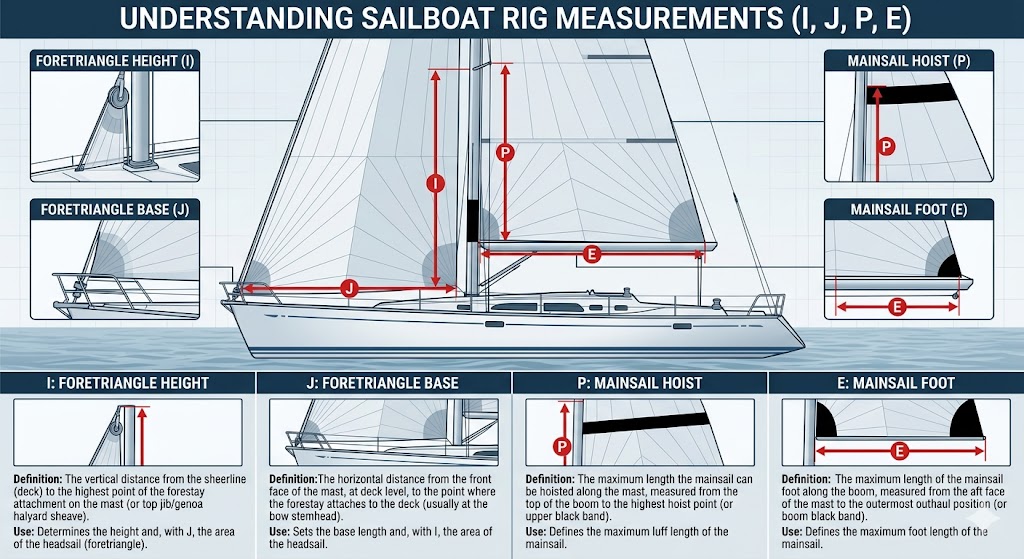
Rig Dimensions
I (Foretriangle Height) 50.50 ft / 15.39 m
J (Foretriangle Base) 18.00 ft / 5.49 m
P (Mainsail Luff) 44.50 ft / 13.56 m
E (Mainsail Foot) 16.00 ft / 4.88 m
SA Fore 454.50 ft² / 42.22 m²
SA Main 356.00 ft² / 33.07 m²
SA Total (100%) 810.50 ft² / 75.30 m²
Est. Forestay Length 53.61 ft / 16.34 m
Engine & Accommodations
Engine Make Perkins
Engine Model 4.154
Engine Type Diesel
Horsepower 62
Fuel Capacity 80 gals / 303 L
Water Capacity 160 gals / 606 L
How It Compares

vs. Caliber 45, Formosa 46, Irwin 45, Lancer 45, Morgan 452

This boat Similar boats
Dimensions
LOA
Gulfstar 44 ★
44.7 ft
Caliber 45
45.0 ft
Formosa 46
45.0 ft
Irwin 45
45.0 ft
Lancer 45
45.0 ft
Morgan 452
45.0 ft
LWL
Gulfstar 44 ★
35.5 ft
Caliber 45
35.8 ft
Formosa 46
39.6 ft
Irwin 45
32.0 ft
Lancer 45
37.3 ft
Morgan 452
39.3 ft
Beam
Gulfstar 44 ★
13.2 ft
Caliber 45
13.3 ft
Formosa 46
12.9 ft
Irwin 45
11.5 ft
Lancer 45
13.8 ft
Morgan 452
13.5 ft
Displacement
Gulfstar 44 ★
26 lbs
Caliber 45
29 lbs
Formosa 46
33 lbs
Irwin 45
23 lbs
Lancer 45
24 lbs
Morgan 452
30 lbs
Ballast
Gulfstar 44 ★
8 lbs
Caliber 45
12 lbs
Formosa 46
10 lbs
Irwin 45
10 lbs
Lancer 45
7 lbs
Morgan 452
8 lbs
Sail Area
Gulfstar 44 ★
697 sq ft
Caliber 45
940 sq ft
Formosa 46
911 sq ft
Irwin 45
882 sq ft
Lancer 45
907 sq ft
Morgan 452
734 sq ft
Performance
PHRF Rating (lower = faster)
Gulfstar 44 ★
138 s/nm
Caliber 45
Formosa 46
128 s/nm
Irwin 45
Lancer 45
162 s/nm
Morgan 452
SA / Displacement (higher = more powerful)
Gulfstar 44 ★
12.8
Caliber 45
16.0
Formosa 46
14.2
Irwin 45
17.5
Lancer 45
17.5
Morgan 452
12.2
Ballast / Disp (higher = stiffer)
Gulfstar 44 ★
32.7 %
Caliber 45
41.4 %
Formosa 46
Irwin 45
Lancer 45
29.2 %
Morgan 452
27.7 %
Comfort Ratio (higher = more comfortable offshore)
Gulfstar 44 ★
34.0
Caliber 45
36.9
Formosa 46
41.0
Irwin 45
38.3
Lancer 45
28.6
Morgan 452
35.4
Capsize Screening (lower = safer)
Gulfstar 44 ★
1.78
Caliber 45
1.74
Formosa 46
1.61
Irwin 45
1.62
Lancer 45
1.91
Morgan 452
1.74
Displacement / Length (lower = lighter)
Gulfstar 44 ★
259
Caliber 45
281
Formosa 46
Irwin 45
Lancer 45
207
Morgan 452
221
Hull Speed
Gulfstar 44 ★
8.0 kts
Caliber 45
8.0 kts
Formosa 46
8.4 kts
Irwin 45
7.6 kts
Lancer 45
8.2 kts
Morgan 452
8.4 kts
Speed Number (higher = faster)
Gulfstar 44 ★
1.9
Caliber 45
Formosa 46
2.0
Irwin 45
Lancer 45
2.7
Morgan 452
Find a Gulfstar 44 For Sale