Back to Search
Flicka 20
Designer: Bruce Bingham  ·  Builder: Nor'star Fiberglass Yachts/Pacific Seacraft (Usa)  ·  First built: 1974
+ Add to Compare
Videos
About the Flicka 20

Designed by Bruce Bingham and first launched in the late 1970s, this diminutive pocket cruiser has earned a devoted following among sailors who appreciate seaworthy performance in a compact package. Despite her modest size, the Flicka 20 demonstrates remarkable ocean-going capabilities that have made her something of a legend in small boat cruising circles. Built with a full keel and heavy displacement design philosophy, she prioritizes stability and seaworthiness over speed. The boat's traditional lines and solid construction reflect Bingham's commitment to creating a miniature version of classic offshore cruising yachts. Her deep cockpit and robust build quality inspire confidence in challenging conditions, while the surprisingly spacious interior accommodates basic cruising amenities. The Flicka 20 excels at coastal cruising and has proven herself capable of extended offshore passages in experienced hands. Several notable circumnavigations have been completed aboard these sturdy little vessels, cementing her reputation as a serious blue-water boat despite her compact dimensions. While not suited for racing or those seeking speed, she appeals to sailors who value traditional sailing characteristics, self-sufficiency, and the ability to explore shallow waters that larger boats cannot access.

Core Dimensions
LOA (Length Overall) 24.00 ft / 7.32 m
LWL (Waterline Length) 18.17 ft / 5.54 m
Beam 8.00 ft / 2.44 m
Max Draft 3.25 ft / 0.99 m
Displacement 6,000.00 lb / 2,722 kg
Ballast 1,750.00 lb / 794 kg
Ballast Type Lead
Sail Area (Reported) 252.29
Design & Construction
Hull Type Long keel w/trans. hung rudder
Rigging Type Cutter
Construction FG
Designer Bruce Bingham
Builder Nor'Star Fiberglass Yachts/Pacific Seacraft (USA)
First Built 1974
Last Built 1999
Number Built 400
Owner Reviews

No owner reviews yet — be the first to share your experience with this boat.

Known Issues & What to Watch For
High Hull/Deck
Early Nor'Star-built Flickas (pre-1978) used a balsa-cored deck in some sections that is prone to water intrusion and rot around deck hardware, chainplates, and stanchion bases. Probe all deck hardware mounting points carefully for soft spots.
pre-1978 Nor'Star models
Medium Hull/Deck
The deck-to-hull joint on Nor'Star-built boats was mechanically fastened and bedded but not glassed over on all examples. This joint can open and allow water intrusion; inspect carefully from both inside and outside.
pre-1978 Nor'Star models
Medium Hull/Deck
The portlights on many Flickas are set into the hull with frames that are difficult to rebед once they begin leaking. Chronic leaking around portlights leading to interior woodwork damage is a commonly reported issue across the production run.
High Keel
The external lead keel is attached with bronze keel bolts that can suffer galvanic corrosion, particularly where the bilge is damp or has standing water. Keel bolt inspection is critical as the long keel design can mask early movement.
High Keel
Some Flickas have shown keel-to-hull joint cracking and bedding compound deterioration at the garboard area, allowing water to wick into the laminate. Look for rust staining or soft laminate at the keel-hull interface.
High Rigging
The chainplate backing plates on early boats are often undersized aluminum or mild steel plates that corrode and lose holding strength. Access to inspect them requires removing interior joinery, and they are frequently found in poor condition.
Nor'Star-built models
Medium Rigging
The mast partner and mast step area on deck-stepped examples is prone to stress cracking and delamination due to the high compression loads on a relatively small hull. Inspect the mast step area from below for delamination or cracking.
Medium Engine
The engine compartment on the Flicka 20 is extremely tight, making routine maintenance very difficult. Many boats have had multiple engine swaps over their lifetime; verify proper mounting, alignment, and that exhaust and cooling systems were correctly reinstalled after any engine change.
Low Accommodations
The interior teak and holly sole and joinery on Nor'Star-built boats used relatively thin veneers over plywood substrates that are susceptible to delamination when bilge moisture or leaks go unaddressed. Check the sole and lower joinery panels carefully for soft spots and bubbling veneer.
Nor'Star-built models
Medium Hull/Deck
The bowsprit, a prominent feature of the Flicka design, is a common source of deck leaks where it is through-bolted to the hull. Water intrusion at the bowsprit root can go undetected and cause delamination or rot in any coring present at the bow.

Own or have surveyed a Flicka 20? Submit a known issue
Performance Ratios
PHRF Rating PHRF (Performance Handicap Racing Fleet) is a national racing handicap measured in seconds per nautical mile. Lower values indicate faster boats. Ratings are sourced from US Sailing's national database (median across 60+ regional fleets).
Under 0 — Ultralight racer0–90 — Performance racer90–150 — Cruiser/racer150–210 — Typical cruiserOver 210 — Heavy/slow cruiser
297
SA/Displacement Sail Area to Displacement ratio measures how much sail power a boat has relative to its weight. Higher values mean more performance and speed.
Under 14 — Heavy cruiser, slow14–18 — Cruising sailboat18–22 — Cruiser/racerOver 22 — Performance racer
12.21
Ballast/Displacement Ballast to Displacement ratio shows what percentage of the boat's total weight is ballast. Higher values generally mean better initial stability and stiffer sail carrying.
30–35% — Typical cruiser35–45% — Stiff performance boatOver 45% — Racing oriented
29.17
Displacement/Length Displacement to Length ratio measures how heavy a boat is relative to its waterline length. Lower values mean a lighter, faster boat.
Under 100 — Ultralight racer100–200 — Light cruiser/racer200–300 — Moderate cruiser300–400 — Heavy cruiserOver 400 — Very heavy
446.52
Pounds/Inch Immersion Pounds per Inch Immersion (PPI) tells you how much weight is needed to sink the boat one inch. Useful for calculating how additional gear and stores affect waterline. 3.11 pounds/inch
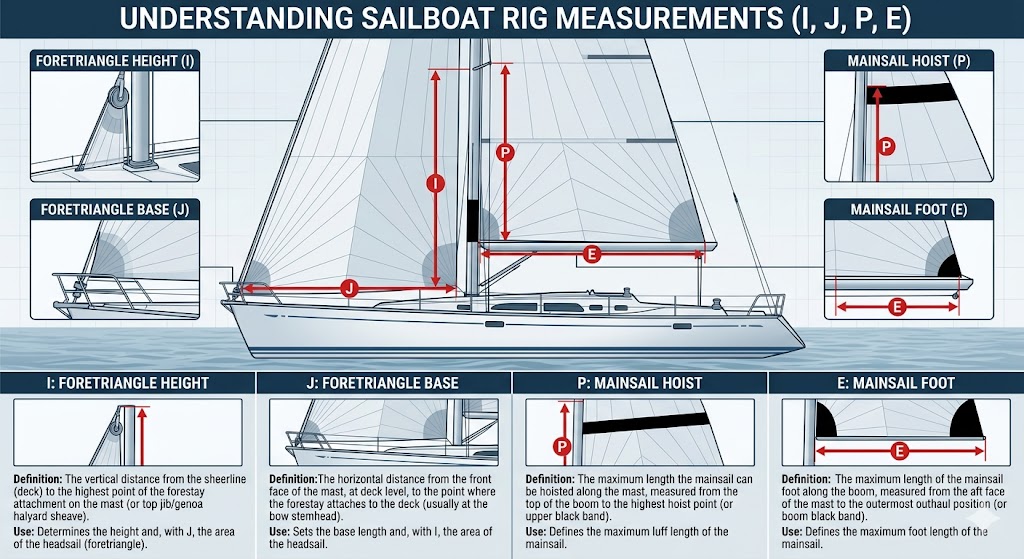
Rig Dimensions
I (Foretriangle Height) 12.15
J (Foretriangle Base) 10.50 ft / 3.20 m
P (Mainsail Luff) 250.00 ft² / 23.23 m²
E (Mainsail Foot) 6.00 ft / 1.83 m
Resources & Community
Find a Flicka 20 For Sale