Back to Search
First 325 Beneteau
Designer: Jean Berret  ·  Builder: Beneteau (Fra)  ·  First built: 1985
+ Add to Compare
Videos
About the First 325 Beneteau

Designed by Jean Berret and launched in 1985, this French-built sailboat represents Beneteau's successful blend of performance and practicality during the mid-1980s sailing boom. The First 325 showcases the era's move toward lighter displacement hulls with modern fin keel and spade rudder configurations, delivering responsive handling that appeals to both weekend cruisers and club racers. With a displacement of 9,700 pounds and 440 square feet of sail area, this 32-footer strikes an appealing balance between stability and speed. The masthead sloop rig provides straightforward sail handling, while the fin keel design offers good windward performance without sacrificing interior volume. A comfort ratio of 20.89 indicates this boat favors performance over heavy-weather comfort, making it well-suited for coastal cruising and bay sailing rather than extended offshore passages. The hull's proportions suggest nimble sailing characteristics, with enough beam to provide reasonable accommodations below. Like many boats in Beneteau's First series, the 325 was designed to offer accessible performance sailing without the extreme nature of pure racing designs. This approach made it popular among sailors seeking a versatile boat capable of spirited day sailing, short cruises, and occasional club racing competition.

Core Dimensions
LOA (Length Overall) 32.48 ft / 9.90 m
LWL (Waterline Length) 27.88 ft / 8.50 m
Beam 11.05 ft / 3.37 m
Max Draft 5.80 ft / 1.77 m
Displacement 9,700.00 lb / 4,400 kg
Ballast 3,747.00 lb / 1,700 kg
Sail Area (Reported) 440.00 ft² / 40.88 m²
Design & Construction
Hull Type Fin w/spade rudder
Rigging Type Masthead Sloop
Construction FG
Designer Jean Berret
Builder Beneteau (FRA)
First Built 1985
Owner Reviews

No owner reviews yet — be the first to share your experience with this boat.

Known Issues & What to Watch For
Medium Hull/Deck
The deck-to-hull joint on early Beneteau First series boats uses an inward-turning flange bonded and through-bolted with relatively few fasteners. This joint is prone to weeping and separation, particularly at the bow and stern quarters where flexing is greatest.
1985–1990 models
High Hull/Deck
The balsa-cored deck used by Beneteau in this era is highly susceptible to water ingress around deck hardware, chainplates, and stanchion bases. Once saturated, the core loses structural integrity and soft spots are common, particularly around the mast base and genoa tracks.
Medium Hull/Deck
The anchor locker and foredeck area are known weak points for core saturation. Water pooling in the anchor locker frequently finds its way into the balsa core, leading to widespread delamination in the forward sections of the deck.
High Keel
The fin keel attachment on early First 325 models uses a relatively shallow sump with a limited number of keel bolts. Keel bolt corrosion and keel-to-hull joint cracking or weeping is a known issue; the joint should be inspected carefully for rust staining, cracking, or movement.
1985–1989 models
High Rigging
The chainplate knees on this model are glassed to the hull liner rather than to the structural hull itself in some configurations, leading to potential delamination of the chainplate backing under load. Verify that chainplates are solidly backed and that surrounding laminate shows no cracking or lifting.
Medium Hull/Deck
Beneteau used a separate interior liner system on the First 325 that is bonded into the hull. Gaps or failures in the bond between liner and hull can create hidden voids, make bilge inspection difficult, and allow water to accumulate in inaccessible areas leading to undetected damage.
Medium Engine
The standard engine installation in this era used a Volvo MD2 or Yanmar 2GM series in a tight, partially enclosed engine compartment with limited airflow. Overheating due to poor ventilation and difficult access for impeller and heat exchanger service are recurring owner complaints.
Medium Accommodations
The hull liner and joinery on early First 325 boats used lightweight, thin panels that are prone to cracking, delamination, and fastener pull-through with age. Compression post and bulkhead tabbing to the liner (rather than the hull) can loosen over time, affecting structural continuity.

Own or have surveyed a First 325 Beneteau? Submit a known issue
Performance Ratios
SA/Displacement Sail Area to Displacement ratio measures how much sail power a boat has relative to its weight. Higher values mean more performance and speed.
Under 14 — Heavy cruiser, slow14–18 — Cruising sailboat18–22 — Cruiser/racerOver 22 — Performance racer
15.53
Ballast/Displacement Ballast to Displacement ratio shows what percentage of the boat's total weight is ballast. Higher values generally mean better initial stability and stiffer sail carrying.
30–35% — Typical cruiser35–45% — Stiff performance boatOver 45% — Racing oriented
38.63
Displacement/Length Displacement to Length ratio measures how heavy a boat is relative to its waterline length. Lower values mean a lighter, faster boat.
Under 100 — Ultralight racer100–200 — Light cruiser/racer200–300 — Moderate cruiser300–400 — Heavy cruiserOver 400 — Very heavy
199.82
Comfort Ratio Ted Brewer's Comfort Ratio predicts how comfortable a boat will feel in offshore conditions. Higher values mean a steadier, more comfortable motion in a seaway.
Under 20 — Uncomfortably rough20–30 — Acceptable coastal30–40 — Good offshore comfortOver 40 — Very comfortable offshore
20.89
Capsize Screening Formula The USHS Capsize Screening Formula estimates offshore capsize risk. Lower is safer — values under 2.0 are considered acceptable for offshore sailing.
Under 2.0 — Safe for offshore2.0–2.2 — Borderline offshoreOver 2.2 — Coastal use recommended
2.08
Hull Speed Hull Speed is the theoretical maximum speed of a displacement hull, calculated from waterline length. Most cruising sailboats reach this speed in moderate conditions. 7.08 kn
S# (Speed Number) The Speed Number (S#) is a quick performance index. Higher values indicate a faster, more powerful design relative to its size.
Under 3.0 — Slow cruiser3.0–5.0 — Average cruiser5.0–7.0 — Performance cruiserOver 7.0 — Racer
2.54
Pounds/Inch Immersion Pounds per Inch Immersion (PPI) tells you how much weight is needed to sink the boat one inch. Useful for calculating how additional gear and stores affect waterline. 1,100.78 pounds/inch
SA/Displacement (Calc) Calculated Sail Area to Displacement ratio using actual measured sail dimensions rather than reported values. More precise than the reported SA/Disp figure. 15.61
Rig Dimensions
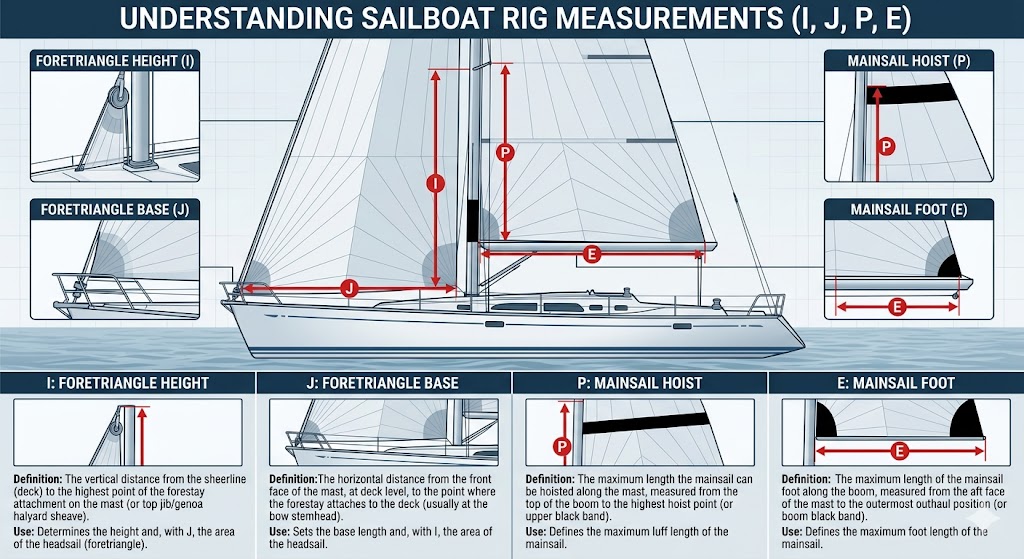
I (Foretriangle Height) 40.30 ft / 12.28 m
J (Foretriangle Base) 12.04 ft / 3.67 m
P (Mainsail Luff) 34.80 ft / 10.61 m
E (Mainsail Foot) 11.48 ft / 3.50 m
SA Fore 242.61 ft² / 22.54 m²
SA Main 199.75 ft² / 18.56 m²
SA Total (100%) 442.36 ft² / 41.10 m²
Est. Forestay Length 42.06 ft / 12.82 m
Engine & Accommodations
Engine Make Volvo
Engine Model 2002
Engine Type Diesel
Fuel Capacity 15 gals / 57 L
Water Capacity 53 gals / 201 L
Find a First 325 Beneteau For Sale