Back to Search
Farr 36 Od 2002
Designer: Bruce Farr  ·  Builder: Betts Ent. (Usa)  ·  First built: 2002
+ Add to Compare
About the Farr 36 Od 2002

Bruce Farr's design expertise shines through in this competitive one-design keelboat that emerged during the early 2000s racing scene. Built with serious racers in mind, this 36-footer represents the kind of purposeful sailing machine that helped establish Farr's reputation for creating fast, well-balanced designs that reward skilled crews. The boat's one-design configuration ensures close, competitive racing where crew skill and tactics matter more than equipment advantages. Its moderate displacement and sleek lines suggest strong performance in a variety of conditions, from light air tactical racing to more demanding offshore events. The design philosophy emphasizes speed and responsiveness while maintaining the kind of seaworthiness expected from a Farr yacht. While primarily conceived for racing, the boat's size and construction quality make it suitable for spirited coastal cruising and club racing programs. The Farr 36 OD attracted sailors looking for serious performance without the complexity and expense of larger racing yachts. Its balanced helm characteristics and predictable handling make it an excellent choice for competitive sailors wanting to hone their skills on a proven platform that delivers consistent performance across varying wind and sea conditions.

Core Dimensions
LOA (Length Overall) 36.10 ft / 11.00 m
LWL (Waterline Length) 32.80 ft / 10.00 m
Beam 11.72 ft / 3.57 m
Max Draft 8.50 ft / 2.59 m
Displacement 6,744.00 lb / 3,059 kg
Ballast 3,078.00 lb / 1,396 kg
Ballast Type Lead
Design & Construction
Hull Type Lifting Keel
Rigging Type Fractional Sloop
Construction Epoxy/Carbon/Foam/Balsa Composite
Designer Bruce Farr
Builder Betts Ent. (USA)
First Built 2002
Last Built 2005
Number Built 6
Owner Reviews

No owner reviews yet — be the first to share your experience with this boat.
Performance Ratios
PHRF Rating PHRF (Performance Handicap Racing Fleet) is a national racing handicap measured in seconds per nautical mile. Lower values indicate faster boats. Ratings are sourced from US Sailing's national database (median across 60+ regional fleets).
Under 0 — Ultralight racer0–90 — Performance racer90–150 — Cruiser/racer150–210 — Typical cruiserOver 210 — Heavy/slow cruiser
9
Ballast/Displacement Ballast to Displacement ratio shows what percentage of the boat's total weight is ballast. Higher values generally mean better initial stability and stiffer sail carrying.
30–35% — Typical cruiser35–45% — Stiff performance boatOver 45% — Racing oriented
45.64
Displacement/Length Displacement to Length ratio measures how heavy a boat is relative to its waterline length. Lower values mean a lighter, faster boat.
Under 100 — Ultralight racer100–200 — Light cruiser/racer200–300 — Moderate cruiser300–400 — Heavy cruiserOver 400 — Very heavy
85.32
Pounds/Inch Immersion Pounds per Inch Immersion (PPI) tells you how much weight is needed to sink the boat one inch. Useful for calculating how additional gear and stores affect waterline. 8.24 pounds/inch
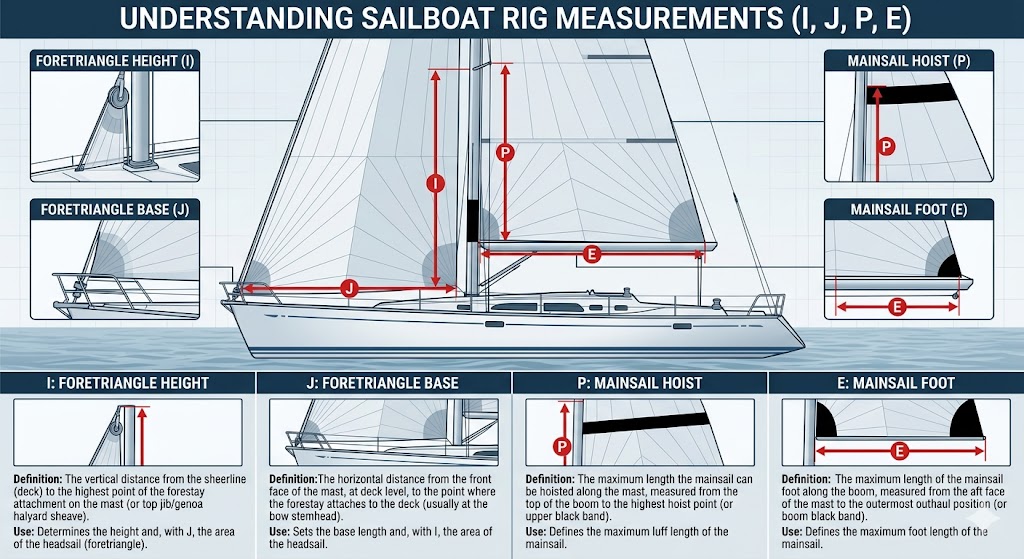
Rig Dimensions
I (Foretriangle Height) 6.00 ft / 1.83 m
J (Foretriangle Base) 13.19 ft / 4.02 m
P (Mainsail Luff) 552.00 ft² / 51.28 m²
E (Mainsail Foot) Yanmar Sail Drive
Engine & Accommodations
Horsepower 20
Find a Farr 36 Od 2002 For Sale