Back to Search
Dart 16
Designer: Yves Loday  ·  Builder: Dart Sailboats  ·  First built: 1997
+ Add to Compare
About the Dart 16

Finding comprehensive information about the Dart 16 can be challenging, as this sailboat appears to be a lesser-documented design with limited specifications readily available. What emerges from the available data suggests a boat that likely falls into the small keelboat or daysailer category, given its numerical designation. Without extensive technical details, the Dart 16 appears to have been designed primarily for recreational sailing and possibly light racing applications. The name "Dart" typically implies a nimble, responsive sailing characteristic, suggesting this boat was intended to offer spirited performance in moderate conditions. Such vessels often excel in protected waters like bays, harbors, and inland lakes, making them suitable for sailors seeking an engaging yet manageable sailing experience. The limited documentation surrounding this model may indicate it had a relatively small production run or served a specific regional market. This scarcity of information doesn't necessarily reflect on the boat's quality or sailing characteristics, but rather suggests it may not have achieved widespread distribution or long-term production success. For prospective buyers researching the Dart 16, connecting with sailing communities or contacting marine surveyors familiar with lesser-known designs would be advisable to gather more comprehensive performance and construction details.

Core Dimensions
LOA (Length Overall) 15.75 ft / 4.80 m
Beam 7.55 ft / 2.30 m
Max Draft 1.64 ft / 0.50 m
Displacement 276.00 lb / 125 kg
Design & Construction
Hull Type Catamaran (no boards/asym.)
Rigging Type Frac. Sloop (Rotating Spar)
Construction Tecrothene 121
Designer Yves Loday
Builder Dart Sailboats
First Built 1997
Owner Reviews

No owner reviews yet — be the first to share your experience with this boat.
Performance Ratios
Displacement/Length Displacement to Length ratio measures how heavy a boat is relative to its waterline length. Lower values mean a lighter, faster boat.
Under 100 — Ultralight racer100–200 — Light cruiser/racer200–300 — Moderate cruiser300–400 — Heavy cruiserOver 400 — Very heavy
51.35
Comfort Ratio Ted Brewer's Comfort Ratio predicts how comfortable a boat will feel in offshore conditions. Higher values mean a steadier, more comfortable motion in a seaway.
Under 20 — Uncomfortably rough20–30 — Acceptable coastal30–40 — Good offshore comfortOver 40 — Very comfortable offshore
2.04
Capsize Screening Formula The USHS Capsize Screening Formula estimates offshore capsize risk. Lower is safer — values under 2.0 are considered acceptable for offshore sailing.
Under 2.0 — Safe for offshore2.0–2.2 — Borderline offshoreOver 2.2 — Coastal use recommended
4.64
Hull Speed Hull Speed is the theoretical maximum speed of a displacement hull, calculated from waterline length. Most cruising sailboats reach this speed in moderate conditions. 4.9 kn
Pounds/Inch Immersion Pounds per Inch Immersion (PPI) tells you how much weight is needed to sink the boat one inch. Useful for calculating how additional gear and stores affect waterline. 2.17 pounds/inch
Rig Dimensions
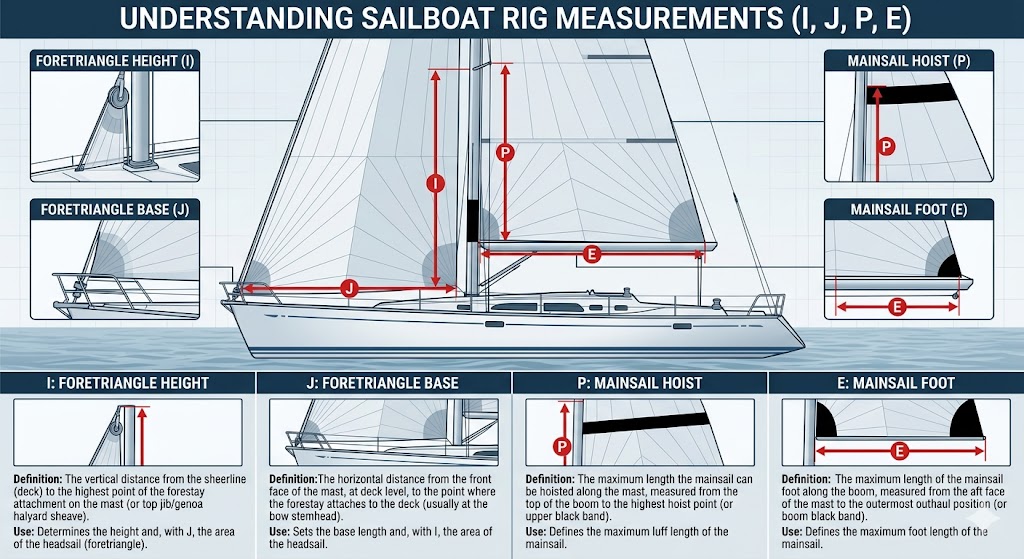
I (Foretriangle Height) 52.89
P (Mainsail Luff) 140.00 ft² / 13.01 m²
E (Mainsail Foot) Yves Loday
Find a Dart 16 For Sale