Back to Search
Ct 35
Designer: William Garden  ·  Builder: Ta Chiao Shipbuilding Co.  ·  First built: 1975
+ Add to Compare
About the Ct 35

With limited documentation available, the Ct 35 represents one of the more elusive designs in the 35-foot sailboat category. This relative scarcity of information suggests either a limited production run or a design that remained within specialized sailing circles, making it an intriguing prospect for sailors seeking something distinctive. Based on its length designation, the Ct 35 would typically fall into the coastal cruising and club racing category, offering a balance between performance and comfort that appeals to sailors looking for weekend adventures and occasional longer passages. Boats in this size range generally provide enough interior space for a small crew while remaining manageable for single-handed or couple sailing. The mystery surrounding this particular design could work in favor of prospective buyers who value uniqueness and are willing to invest time in research and potentially sourcing parts through specialized channels. However, the limited available specifications mean that anyone seriously considering a Ct 35 should conduct thorough inspections and seek out existing owners or sailing communities that might have hands-on experience with the design. This approach becomes particularly important when evaluating the boat's construction quality, sailing characteristics, and long-term maintenance requirements.

Core Dimensions
LOA (Length Overall) 35.00 ft / 10.67 m
LWL (Waterline Length) 26.83 ft / 8.18 m
Beam 11.17 ft / 3.40 m
Max Draft 4.75 ft / 1.45 m
Displacement 16,900.00 lb / 7,666 kg
Ballast 5,300.00 lb / 2,404 kg
Sail Area (Reported) 483.00 ft² / 44.87 m²
Design & Construction
Hull Type Long Keel
Rigging Type Staysail Ketch
Construction FG
Designer William Garden
Builder Ta Chiao Shipbuilding Co.
First Built 1975
Owner Reviews

No owner reviews yet — be the first to share your experience with this boat.

Known Issues & What to Watch For
High Hull/Deck
The deck-to-hull joint on CT 35s built by Ta Chiao is an inward-turning flange bedded in polyester putty rather than a proper marine sealant. This joint is prone to weeping, and water intrusion can migrate into the balsa or plywood core used in deck sections, causing soft spots particularly around the toerail and chainplate areas.
High Hull/Deck
Ta Chiao used balsa core extensively in the deck construction, and moisture intrusion around deck hardware fittings — cleats, stanchion bases, and winch pads — is extremely common due to inadequate original bedding and the use of through-bolts without proper backing plates. Tap the deck carefully for soft or delaminated areas.
High Keel
The long keel is encapsulated ballast (lead or iron depending on build), and the garboard seam area where the keel meets the hull can develop stress cracks and weeping on older hulls. The keel-to-hull joint should be closely inspected for separation or repair history, as this area sees significant stress in a full-keel boat.
High Hull/Deck
Chainplate backing plates used by Ta Chiao were often undersized plywood or thin aluminum embedded in the fiberglass, which can rot or corrode over time. Chainplates should be pulled and the backing structure inspected, as failure here is a dismasting risk.
High Rigging
The original chainplates on CT 35s are typically mild steel or low-grade stainless that corrodes at the deck penetration point, which is often sealed over and traps moisture. Many boats of this vintage have hidden crevice corrosion at the deck-level chainplate penetration that is not visible without pulling the chainplates.
Medium Engine
Many CT 35s were fitted with older Perkins 4-108 or similar vintage diesels that may be approaching or beyond reliable service life. Raw water cooling passages in these engines are prone to internal corrosion and scaling; heat exchanger integrity and raw water impeller housing condition should be carefully assessed.
Medium Accommodations
Ta Chiao's joinery used teak extensively with plywood substrates that are prone to delamination if any moisture has penetrated the interior. Check under settee cushions, beneath the sole boards, and behind headliner panels for soft or swollen plywood, particularly in the forward cabin and head compartment.
Medium Electrical
Original Taiwanese electrical wiring on Ta Chiao boats of this era was generally substandard — undersized conductors, non-tinned copper, and poor terminal crimps are common. Most CT 35s of any age will have had some rewiring, but partial rewiring can leave dangerous original wiring in place; the entire system should be inspected.
Medium Hull/Deck
The teak laid deck over the fiberglass deck — common on CT 35s — can allow water infiltration through dried-out caulking seams into the underlying balsa core. Recaulking history and the condition of the underlying deck beneath the teak should be investigated, particularly near scuppers and deck hardware.

Own or have surveyed a Ct 35? Submit a known issue
Performance Ratios
PHRF Rating PHRF (Performance Handicap Racing Fleet) is a national racing handicap measured in seconds per nautical mile. Lower values indicate faster boats. Ratings are sourced from US Sailing's national database (median across 60+ regional fleets).
Under 0 — Ultralight racer0–90 — Performance racer90–150 — Cruiser/racer150–210 — Typical cruiserOver 210 — Heavy/slow cruiser
198
SA/Displacement Sail Area to Displacement ratio measures how much sail power a boat has relative to its weight. Higher values mean more performance and speed.
Under 14 — Heavy cruiser, slow14–18 — Cruising sailboat18–22 — Cruiser/racerOver 22 — Performance racer
11.78
Comfort Ratio Ted Brewer's Comfort Ratio predicts how comfortable a boat will feel in offshore conditions. Higher values mean a steadier, more comfortable motion in a seaway.
Under 20 — Uncomfortably rough20–30 — Acceptable coastal30–40 — Good offshore comfortOver 40 — Very comfortable offshore
35.85
Capsize Screening Formula The USHS Capsize Screening Formula estimates offshore capsize risk. Lower is safer — values under 2.0 are considered acceptable for offshore sailing.
Under 2.0 — Safe for offshore2.0–2.2 — Borderline offshoreOver 2.2 — Coastal use recommended
1.74
Hull Speed Hull Speed is the theoretical maximum speed of a displacement hull, calculated from waterline length. Most cruising sailboats reach this speed in moderate conditions. 6.94
S# (Speed Number) The Speed Number (S#) is a quick performance index. Higher values indicate a faster, more powerful design relative to its size.
Under 3.0 — Slow cruiser3.0–5.0 — Average cruiser5.0–7.0 — Performance cruiserOver 7.0 — Racer
0.87
Pounds/Inch Immersion Pounds per Inch Immersion (PPI) tells you how much weight is needed to sink the boat one inch. Useful for calculating how additional gear and stores affect waterline. 1.0
Rig Dimensions
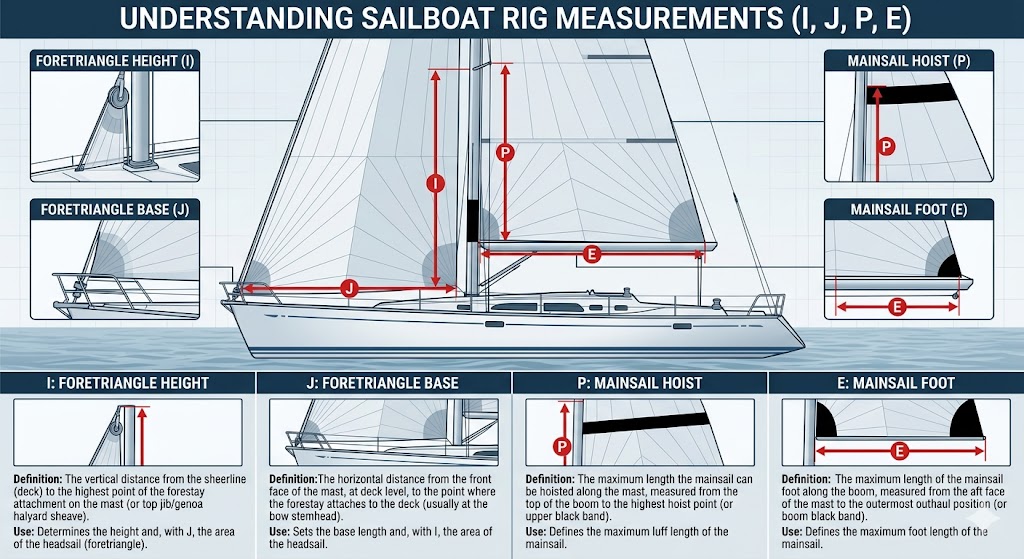
I (Foretriangle Height) 38.0
J (Foretriangle Base) 13.0
P (Mainsail Luff) 33.7
E (Mainsail Foot) 14.0
SA Fore 247.0
SA Main 235.9
Find a Ct 35 For Sale