Back to Search
Ct 34
Designer: C. S. Chen  ·  Builder: Ta Chiao  ·  First built: 1970
+ Add to Compare
About the Ct 34

With limited specification data available, the Ct 34 represents one of the more elusive designs in the 34-foot sailing yacht category. This relative obscurity in the sailing community suggests either limited production numbers or a regional distribution pattern that kept the model from achieving widespread recognition. Based on its length designation, this sailboat would typically fall into the coastal cruising and light offshore sailing category, suitable for weekend getaways and extended coastal passages. Boats in this size range generally offer a practical balance between manageable single-handed sailing and comfortable accommodations for small crews or families. The scarcity of detailed information about the Ct 34 makes it an intriguing prospect for sailors who appreciate unique or uncommon designs. However, this same rarity could present challenges for prospective owners in terms of finding replacement parts, accessing technical support, or connecting with other owners for advice and shared experiences. For sailors considering this model, thorough research into the builder's reputation, construction quality, and available support network would be essential. The limited documentation suggests approaching any Ct 34 purchase with careful attention to survey findings and mechanical systems evaluation.

Core Dimensions
LOA (Length Overall) 33.25 ft / 10.13 m
LWL (Waterline Length) 27.67 ft / 8.43 m
Beam 10.25 ft / 3.12 m
Max Draft 5.00 ft / 1.52 m
Displacement 16,100.00 lb / 7,303 kg
Ballast 5,300.00 lb / 2,404 kg
Ballast Type Iron
Design & Construction
Hull Type Long Keel
Rigging Type Cutter
Construction FG
Designer C. S. Chen
Builder Ta Chiao
First Built 1970
Last Built 1987
Number Built 43
Owner Reviews

No owner reviews yet — be the first to share your experience with this boat.

Known Issues & What to Watch For
High Hull/Deck
The CT 34 was built with a balsa-cored deck in many sections. Ta Chiao's coring technique and resin application was inconsistent, and water intrusion around chainplates, stanchion bases, and deck hardware has led to widespread balsa rot in the core, sometimes extensively. Any deck survey should probe all hardware penetrations carefully.
High Hull/Deck
The teak decks common on CT 34s were fastened with screws through the fiberglass deck, creating hundreds of potential water intrusion points. Over time, the bedding compound fails and water works into the balsa core below. Many owners have had to remove teak decks entirely and rebond or replace the core.
High Keel
The CT 34 uses a long keel with an external lead ballast section attached with keel bolts. The bilge area around the keel sump is prone to standing water accumulation, which accelerates keel bolt corrosion. Bolts should be inspected and tested for integrity, as replacement is a major undertaking on this hull.
High Rigging
Chainplate attachment on the CT 34 passes through the balsa-cored deck without adequate backing or sealing in many examples. The combination of deck flex and water intrusion at these points has caused chainplate tabbing to delaminate from the hull interior. Inspection of the interior chainplate attachment points and associated glasswork is essential.
Medium Hull/Deck
The hull-to-deck joint on Ta Chiao boats of this era was typically an inward-turned flange bonded and pop-riveted, then covered with a toerail. Sealant failure is extremely common after 30–40 years, allowing water ingress along the entire joint. Separation of the joint can be difficult to detect without removing the toerail.
High Electrical
Boats imported in the 1970s and early 1980s were wired with substandard wire gauge and non-tinned copper wiring that corrodes readily in the marine environment. Most CT 34s of this age require a full electrical rewire, and the original wiring should be treated as a fire hazard until inspected by a marine electrician.
1970–1982 models
Medium Engine
Many CT 34s were fitted with the Perkins 4-108 diesel. While generally robust, the raw water cooling system impeller housing and heat exchanger on aging examples is frequently corroded or leaking. The engine beds on some boats show soft or delaminated glasswork from years of bilge water exposure.
Medium Accommodations
The interior joinery on CT 34s used teak and holly veneer over plywood. Teak trim is generally durable, but the underlying plywood substrate in settee bases, the chart table, and the galley area is prone to delamination and rot when bilge water or deck leaks are present, which is common on boats of this era.
Medium Hull/Deck
Portlight and window frames on the CT 34 are often bronze or aluminum set in teak surrounds. Sealant failure is nearly universal on older examples, and water has often tracked into the cabin side laminate. Check for soft spots in the fiberglass around every opening.

Own or have surveyed a Ct 34? Submit a known issue
Performance Ratios
Ballast/Displacement Ballast to Displacement ratio shows what percentage of the boat's total weight is ballast. Higher values generally mean better initial stability and stiffer sail carrying.
30–35% — Typical cruiser35–45% — Stiff performance boatOver 45% — Racing oriented
32.92
Displacement/Length Displacement to Length ratio measures how heavy a boat is relative to its waterline length. Lower values mean a lighter, faster boat.
Under 100 — Ultralight racer100–200 — Light cruiser/racer200–300 — Moderate cruiser300–400 — Heavy cruiserOver 400 — Very heavy
339.27
Pounds/Inch Immersion Pounds per Inch Immersion (PPI) tells you how much weight is needed to sink the boat one inch. Useful for calculating how additional gear and stores affect waterline. 6.08 pounds/inch
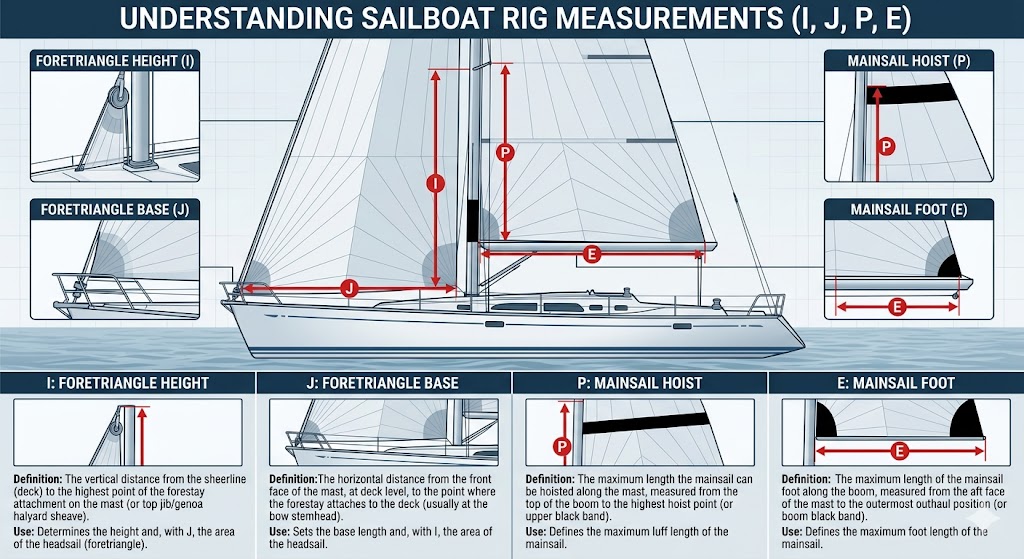
Rig Dimensions
I (Foretriangle Height) 14.99
P (Mainsail Luff) 595.00 ft² / 55.28 m²
E (Mainsail Foot) Yanmar
Engine & Accommodations
Horsepower 22
Fuel Capacity 50 gals / 189 L
Water Capacity 50 gals / 189 L
Find a Ct 34 For Sale