Back to Search
Creekmore 40
Designer: Creekmore  ·  Builder: Various  ·  First built: 1980
+ Add to Compare
About the Creekmore 40

Designed and first launched in 1980, this distinctive 40-footer represents a classic approach to blue water cruising with its robust cutter rig configuration and substantial displacement design. With only eight hulls ever constructed by various builders, the Creekmore 40 stands as a rare gem in the sailing world, appealing to discerning cruisers who value traditional seaworthiness over mass production conveniences. The boat's impressive displacement of 24,000 pounds combined with a moderate sail area creates a stable, comfortable platform ideally suited for extended offshore passages. Its excellent comfort ratio of 31.79 reflects the designer's emphasis on livability at sea, while the conservative capsize screening formula of 1.88 indicates exceptional stability and safety margins for serious ocean cruising. The cutter rig provides excellent sail handling versatility, particularly valuable when managing varying wind conditions during long passages. Built with fiberglass construction and featuring a fin keel configuration, this design strikes an effective balance between traditional cruising virtues and reasonable performance. The hull's proportions suggest a seakindly motion and predictable handling characteristics that experienced cruisers appreciate. For sailors seeking a proven offshore cruiser with traditional values and exceptional seaworthiness, the Creekmore 40's rarity only adds to its appeal among knowledgeable blue water enthusiasts.

Core Dimensions
LOA (Length Overall) 39.83 ft / 12.14 m
LWL (Waterline Length) 35.00 ft / 10.67 m
Beam 13.50 ft / 4.11 m
Max Draft 5.50 ft / 1.68 m
Displacement 24,000.00 lb / 10,886 kg
Sail Area (Reported) 794.00 ft² / 73.77 m²
Design & Construction
Hull Type Fin Keel
Rigging Type Cutter
Construction FG
Designer Creekmore
Builder Various
First Built 1980
Number Built 8
Owner Reviews

No owner reviews yet — be the first to share your experience with this boat.
Performance Ratios
PHRF Rating PHRF (Performance Handicap Racing Fleet) is a national racing handicap measured in seconds per nautical mile. Lower values indicate faster boats. Ratings are sourced from US Sailing's national database (median across 60+ regional fleets).
Under 0 — Ultralight racer0–90 — Performance racer90–150 — Cruiser/racer150–210 — Typical cruiserOver 210 — Heavy/slow cruiser
96
SA/Displacement Sail Area to Displacement ratio measures how much sail power a boat has relative to its weight. Higher values mean more performance and speed.
Under 14 — Heavy cruiser, slow14–18 — Cruising sailboat18–22 — Cruiser/racerOver 22 — Performance racer
15.33
Displacement/Length Displacement to Length ratio measures how heavy a boat is relative to its waterline length. Lower values mean a lighter, faster boat.
Under 100 — Ultralight racer100–200 — Light cruiser/racer200–300 — Moderate cruiser300–400 — Heavy cruiserOver 400 — Very heavy
249.9
Comfort Ratio Ted Brewer's Comfort Ratio predicts how comfortable a boat will feel in offshore conditions. Higher values mean a steadier, more comfortable motion in a seaway.
Under 20 — Uncomfortably rough20–30 — Acceptable coastal30–40 — Good offshore comfortOver 40 — Very comfortable offshore
31.79
Capsize Screening Formula The USHS Capsize Screening Formula estimates offshore capsize risk. Lower is safer — values under 2.0 are considered acceptable for offshore sailing.
Under 2.0 — Safe for offshore2.0–2.2 — Borderline offshoreOver 2.2 — Coastal use recommended
1.88
Hull Speed Hull Speed is the theoretical maximum speed of a displacement hull, calculated from waterline length. Most cruising sailboats reach this speed in moderate conditions. 7.93 kn
S# (Speed Number) The Speed Number (S#) is a quick performance index. Higher values indicate a faster, more powerful design relative to its size.
Under 3.0 — Slow cruiser3.0–5.0 — Average cruiser5.0–7.0 — Performance cruiserOver 7.0 — Racer
2.01
Pounds/Inch Immersion Pounds per Inch Immersion (PPI) tells you how much weight is needed to sink the boat one inch. Useful for calculating how additional gear and stores affect waterline. 1,688.29 pounds/inch
SA/Displacement (Calc) Calculated Sail Area to Displacement ratio using actual measured sail dimensions rather than reported values. More precise than the reported SA/Disp figure. 15.33
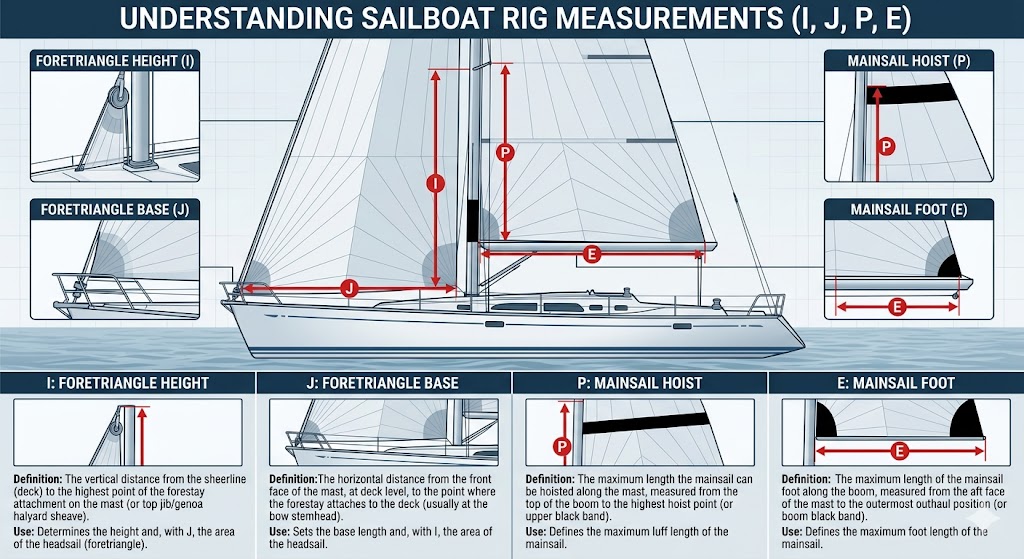
Rig Dimensions
I (Foretriangle Height) 49.00 ft / 14.94 m
J (Foretriangle Base) 15.75 ft / 4.80 m
P (Mainsail Luff) 48.75 ft / 14.86 m
E (Mainsail Foot) 16.75 ft / 5.11 m
SA Fore 385.88 ft² / 35.85 m²
SA Main 408.28 ft² / 37.93 m²
SA Total (100%) 794.16 ft² / 73.78 m²
Est. Forestay Length 51.47 ft / 15.69 m
How It Compares

vs. Allied 39, Pearson 40, Swan 391

This boat Similar boats
Dimensions
LOA
Creekmore 40 ★
39.8 ft
Allied 39
39.8 ft
Pearson 40
39.9 ft
Swan 391
39.9 ft
LWL
Creekmore 40 ★
35.0 ft
Allied 39
28.8 ft
Pearson 40
31.3 ft
Swan 391
33.1 ft
Beam
Creekmore 40 ★
13.5 ft
Allied 39
10.5 ft
Pearson 40
12.5 ft
Swan 391
12.4 ft
Displacement
Creekmore 40 ★
24 lbs
Allied 39
17 lbs
Pearson 40
22 lbs
Swan 391
18 lbs
Ballast
Creekmore 40 ★
Allied 39
6 lbs
Pearson 40
12 lbs
Swan 391
6 lbs
Sail Area
Creekmore 40 ★
794 sq ft
Allied 39
680 sq ft
Pearson 40
Swan 391
767 sq ft
Performance
PHRF Rating (lower = faster)
Creekmore 40 ★
96 s/nm
Allied 39
Pearson 40
117 s/nm
Swan 391
90 s/nm
SA / Displacement (higher = more powerful)
Creekmore 40 ★
15.3
Allied 39
16.5
Pearson 40
Swan 391
17.4
Ballast / Disp (higher = stiffer)
Creekmore 40 ★
Allied 39
39.4 %
Pearson 40
53.5 %
Swan 391
Comfort Ratio (higher = more comfortable offshore)
Creekmore 40 ★
31.8
Allied 39
35.7
Pearson 40
Swan 391
29.0
Capsize Screening (lower = safer)
Creekmore 40 ★
1.88
Allied 39
1.64
Pearson 40
Swan 391
1.87
Displacement / Length (lower = lighter)
Creekmore 40 ★
249
Allied 39
316
Pearson 40
333
Swan 391
Hull Speed
Creekmore 40 ★
7.9 kts
Allied 39
7.2 kts
Pearson 40
Swan 391
7.7 kts
Speed Number (higher = faster)
Creekmore 40 ★
2.0
Allied 39
1.6
Pearson 40
Swan 391
2.4
Find a Creekmore 40 For Sale