Back to Search
Clipper Marine 30
Designer: W.i.b. Crealock  ·  Builder: Clipper Marine (Usa)  ·  First built: 1974
+ Add to Compare
About the Clipper Marine 30

Designed as a versatile coastal cruiser, this 30-foot sailboat emerged during an era when builders focused on creating affordable yet seaworthy vessels for the growing recreational sailing market. The Clipper Marine 30 represents a thoughtful approach to small boat cruising, balancing comfort with sailing performance in a manageable size. With her moderate displacement and traditional sailplan, this boat appeals to sailors seeking weekend adventures and short coastal passages. The design emphasizes ease of handling, making her particularly suitable for couples or small families looking to explore protected waters and nearby anchorages. Her size strikes an appealing balance—large enough to provide reasonable accommodations for extended outings, yet small enough for single-handed sailing when conditions permit. The boat's construction reflects the building standards of her period, with attention paid to creating a sturdy platform that could handle typical coastal conditions. Her cockpit and deck layout prioritize practical sailing, while below decks, the accommodation plan makes efficient use of the available space. For sailors considering their first serious cruising boat or those seeking a manageable vessel for regional exploration, the Clipper Marine 30 offers an interesting option worth investigating further.

Core Dimensions
LOA (Length Overall) 30.00 ft / 9.14 m
LWL (Waterline Length) 25.00 ft / 7.62 m
Beam 8.00 ft / 2.44 m
Max Draft 3.50 ft / 1.07 m
Displacement 3,500.00 lb / 1,588 kg
Ballast 800.00 lb / 363 kg
Ballast Type Iron
Design & Construction
Hull Type Fin w/transom hung rudder
Rigging Type Masthead Sloop
Construction FG
Designer W.I.B. Crealock
Builder Clipper Marine (USA)
First Built 1974
Owner Reviews

No owner reviews yet — be the first to share your experience with this boat.
Performance Ratios
PHRF Rating PHRF (Performance Handicap Racing Fleet) is a national racing handicap measured in seconds per nautical mile. Lower values indicate faster boats. Ratings are sourced from US Sailing's national database (median across 60+ regional fleets).
Under 0 — Ultralight racer0–90 — Performance racer90–150 — Cruiser/racer150–210 — Typical cruiserOver 210 — Heavy/slow cruiser
273
Ballast/Displacement Ballast to Displacement ratio shows what percentage of the boat's total weight is ballast. Higher values generally mean better initial stability and stiffer sail carrying.
30–35% — Typical cruiser35–45% — Stiff performance boatOver 45% — Racing oriented
22.86
Displacement/Length Displacement to Length ratio measures how heavy a boat is relative to its waterline length. Lower values mean a lighter, faster boat.
Under 100 — Ultralight racer100–200 — Light cruiser/racer200–300 — Moderate cruiser300–400 — Heavy cruiserOver 400 — Very heavy
100
Pounds/Inch Immersion Pounds per Inch Immersion (PPI) tells you how much weight is needed to sink the boat one inch. Useful for calculating how additional gear and stores affect waterline. 4.29 pounds/inch
Rig Dimensions
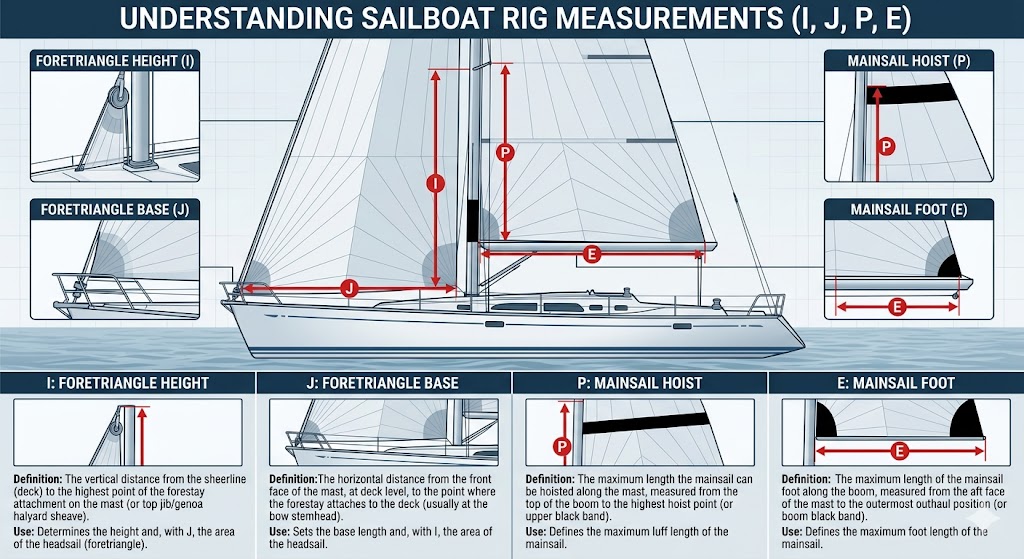
I (Foretriangle Height) 19.07
J (Foretriangle Base) 12.76 ft / 3.89 m
P (Mainsail Luff) 274.00 ft² / 25.46 m²
E (Mainsail Foot) 100.00
Find a Clipper Marine 30 For Sale