Back to Search
Cherub
Designer: Development Clas  ·  First built: 1951
+ Add to Compare
About the Cherub

Dating back to the 1950s, this distinctive New Zealand-designed skiff represents one of sailing's most exhilarating single-handed racing classes. Originally conceived by John Spencer, the Cherub quickly gained recognition for its innovative approach to small boat performance, featuring an unusually wide beam and lightweight construction that was revolutionary for its era. Built for pure speed and excitement, these boats demand skilled handling and reward aggressive sailing techniques. The design's emphasis on planing performance and responsiveness makes it ideally suited for competitive racing in protected waters, where crews can fully exploit the boat's impressive power-to-weight ratio. The Cherub's reputation for providing thrilling rides has made it a favorite among sailors seeking an adrenaline-fueled racing experience. While primarily designed for single-handed racing, the boat's challenging nature means it's best suited for experienced sailors who appreciate technical sailing and aren't intimidated by a craft that requires constant attention and quick reflexes. The class maintains an active racing circuit, particularly in Australia and New Zealand, where enthusiasts continue to push these nimble craft to their impressive limits on inland lakes and protected coastal waters.

Core Dimensions
LOA (Length Overall) 12.16 ft / 3.71 m
Beam 5.92 ft / 1.80 m
Displacement 110.00 lb / 50 kg
Design & Construction
Hull Type Centerboard Dinghy
Rigging Type Fractional Sloop
Construction Any
Designer Development Clas
First Built 1951
Related Sailboats ["Firefly" · "Solo" · "Graduate" · "Hobie Bravo" · "Byte"]
Owner Reviews

No owner reviews yet — be the first to share your experience with this boat.
Performance Ratios
Displacement/Length Displacement to Length ratio measures how heavy a boat is relative to its waterline length. Lower values mean a lighter, faster boat.
Under 100 — Ultralight racer100–200 — Light cruiser/racer200–300 — Moderate cruiser300–400 — Heavy cruiserOver 400 — Very heavy
44.47
Comfort Ratio Ted Brewer's Comfort Ratio predicts how comfortable a boat will feel in offshore conditions. Higher values mean a steadier, more comfortable motion in a seaway.
Under 20 — Uncomfortably rough20–30 — Acceptable coastal30–40 — Good offshore comfortOver 40 — Very comfortable offshore
1.45
Hull Speed Hull Speed is the theoretical maximum speed of a displacement hull, calculated from waterline length. Most cruising sailboats reach this speed in moderate conditions. 4.31 kn
Pounds/Inch Immersion Pounds per Inch Immersion (PPI) tells you how much weight is needed to sink the boat one inch. Useful for calculating how additional gear and stores affect waterline. 1.31 pounds/inch
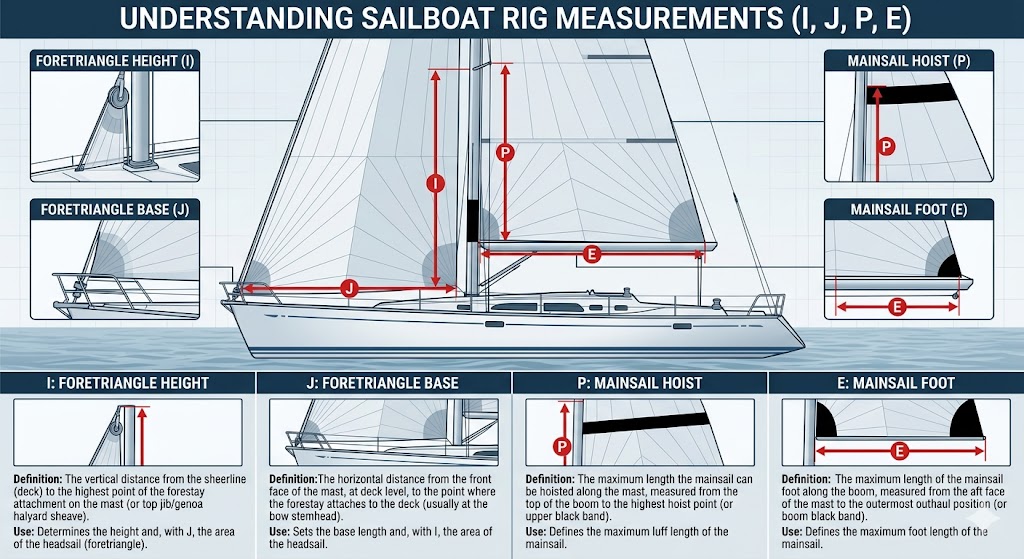
Rig Dimensions
I (Foretriangle Height) 94.12
P (Mainsail Luff) 135.00 ft² / 12.54 m²
E (Mainsail Foot) Ben Lexcen
How It Compares

vs. Graduate, Hobie Bravo, Solo

This boat Similar boats
Dimensions
LOA
Cherub ★
12.2 ft
Graduate
12.5 ft
Hobie Bravo
12.0 ft
Solo
12.4 ft
Beam
Cherub ★
5.9 ft
Graduate
4.7 ft
Hobie Bravo
4.4 ft
Solo
5.3 ft
Displacement
Cherub ★
110 lbs
Graduate
185 lbs
Hobie Bravo
195 lbs
Solo
150 lbs
Sail Area
Cherub ★
Graduate
108 sq ft
Hobie Bravo
86 sq ft
Solo
90 sq ft
Performance
SA / Displacement (higher = more powerful)
Cherub ★
Graduate
53.3
Hobie Bravo
41.0
Solo
51.0
Comfort Ratio (higher = more comfortable offshore)
Cherub ★
1.5
Graduate
3.3
Hobie Bravo
3.9
Solo
Capsize Screening (lower = safer)
Cherub ★
Graduate
Hobie Bravo
3.05
Solo
3.95
Displacement / Length (lower = lighter)
Cherub ★
44
Graduate
68
Hobie Bravo
82
Solo
Hull Speed
Cherub ★
4.3 kts
Graduate
4.4 kts
Hobie Bravo
4.3 kts
Solo
Find a Cherub For Sale