Back to Search
Catalina 380
Designer: G. Douglas / Catalina  ·  Builder: Catalina Yachts (Usa)  ·  First built: 1997
+ Add to Compare
Videos
About the Catalina 380

Designed by Gerry Douglas and launched in 1997, this popular mid-size cruiser from Catalina Yachts represents the builder's commitment to creating accessible, well-balanced sailboats for coastal and offshore cruising. The masthead sloop configuration and fin keel with spade rudder design deliver predictable handling characteristics that have made this model a favorite among both experienced sailors and those transitioning to larger boats. With a displacement of 19,000 pounds and 6,800 pounds of ballast, the 380 offers reassuring stability while maintaining reasonable performance under sail. The moderate sail area of 723 square feet provides a good balance between power and manageability, with a SA/Displacement ratio of 16.31 indicating solid cruising performance without being overly aggressive. The comfort ratio of 30.24 suggests this boat prioritizes seaworthiness and motion comfort over pure speed, making it well-suited for extended passages and live-aboard cruising. The fiberglass construction and proven hull design have earned this model a reputation for durability and value retention. Its capsize screening formula of 1.85 indicates good offshore capability, while the hull speed of 7.63 knots provides respectable passage-making potential. The standard 42-horsepower auxiliary engine ensures reliable maneuvering in close quarters and motoring in calm conditions.

Core Dimensions
LOA (Length Overall) 38.42 ft / 11.71 m
LWL (Waterline Length) 32.42 ft / 9.88 m
Beam 12.33 ft / 3.76 m
Max Draft 7.17 ft / 2.19 m
Displacement 19,000.00 lb / 8,618 kg
Ballast 6,800.00 lb / 3,084 kg
Sail Area (Reported) 723.00 ft² / 67.17 m²
Design & Construction
Hull Type Fin w/spade rudder
Rigging Type Masthead Sloop
Construction FG
Designer G. Douglas / Catalina
Builder Catalina Yachts (USA)
First Built 1997
Associations Catalina 380 Association
Owner Reviews

No owner reviews yet — be the first to share your experience with this boat.

Known Issues & What to Watch For
Medium Hull/Deck
The deck-to-hull joint on the Catalina 380 uses an inward-turning flange bonded and through-bolted, but the toerail screws along this joint are prone to leaking, allowing water intrusion into the balsa-cored deck sections. Check for soft spots along the toerail, especially at the bow and stern quarters.
High Hull/Deck
The balsa core used in the deck is vulnerable to moisture intrusion around chainplate and stanchion base fittings. Delamination and rot in the balsa core beneath stanchion bases is a well-documented issue on this model; probe all bases carefully during survey.
Medium Hull/Deck
The portlight frames (both fixed and opening) on early 380s are known to leak at the frame-to-deck seal, leading to water intrusion into the cabin liner and potential core saturation in the coachroof.
1997–2002 models
High Keel
The fin keel on the 380 is attached with keel bolts that pass through a relatively shallow sump. Keel bolt corrosion and weeping at the keel-to-hull joint is a known concern; inspect the bilge sump carefully for rust staining, and verify all keel bolts are tight with no signs of movement.
High Rigging
The chainplate knees on the Catalina 380 are glassed to the hull liner rather than the hull itself on some production runs. This arrangement can allow flexing and eventual failure of the glass tabbing; inspect for cracking or separation at the chainplate-to-liner interface.
Medium Rigging
The aluminum mast step casting on deck-stepped masts is prone to cracking and corrosion, particularly where water pools around the base. Inspect the mast step and surrounding deck core for softness and structural integrity.
Medium Engine
The 380 was typically fitted with a Universal M35B or M40B diesel. The raw water impeller housing and heat exchanger on these engines are prone to scaling and early failure in salt water use; verify full service history and check for overheating incidents.
Low Engine
The engine access on the 380, via a companionway drop-board and cockpit locker, is awkward and limits routine maintenance visibility. Neglected engine mounts, stuffing boxes, and transmission fluid levels are common findings due to difficult access.
Medium Electrical
Early Catalina 380s left the factory with undersized battery banks and minimal DC wiring for the equipment buyers typically add. Wiring additions are often done informally by owners; inspect the DC panel and bilge wiring closely for amateur splices and overloaded circuits.
1997–2001 models
Low Accommodations
The hull liner-to-hull bond on Catalina 380s can develop voids and separations over time, leading to creaking and flexing of the interior furniture and headliner in a seaway. This is a known Catalina construction characteristic and can be difficult to fully repair.

Own or have surveyed a Catalina 380? Submit a known issue
Performance Ratios
PHRF Rating PHRF (Performance Handicap Racing Fleet) is a national racing handicap measured in seconds per nautical mile. Lower values indicate faster boats. Ratings are sourced from US Sailing's national database (median across 60+ regional fleets).
Under 0 — Ultralight racer0–90 — Performance racer90–150 — Cruiser/racer150–210 — Typical cruiserOver 210 — Heavy/slow cruiser
120
SA/Displacement Sail Area to Displacement ratio measures how much sail power a boat has relative to its weight. Higher values mean more performance and speed.
Under 14 — Heavy cruiser, slow14–18 — Cruising sailboat18–22 — Cruiser/racerOver 22 — Performance racer
16.31
Ballast/Displacement Ballast to Displacement ratio shows what percentage of the boat's total weight is ballast. Higher values generally mean better initial stability and stiffer sail carrying.
30–35% — Typical cruiser35–45% — Stiff performance boatOver 45% — Racing oriented
35.79
Displacement/Length Displacement to Length ratio measures how heavy a boat is relative to its waterline length. Lower values mean a lighter, faster boat.
Under 100 — Ultralight racer100–200 — Light cruiser/racer200–300 — Moderate cruiser300–400 — Heavy cruiserOver 400 — Very heavy
248.92
Comfort Ratio Ted Brewer's Comfort Ratio predicts how comfortable a boat will feel in offshore conditions. Higher values mean a steadier, more comfortable motion in a seaway.
Under 20 — Uncomfortably rough20–30 — Acceptable coastal30–40 — Good offshore comfortOver 40 — Very comfortable offshore
30.24
Capsize Screening Formula The USHS Capsize Screening Formula estimates offshore capsize risk. Lower is safer — values under 2.0 are considered acceptable for offshore sailing.
Under 2.0 — Safe for offshore2.0–2.2 — Borderline offshoreOver 2.2 — Coastal use recommended
1.85
Hull Speed Hull Speed is the theoretical maximum speed of a displacement hull, calculated from waterline length. Most cruising sailboats reach this speed in moderate conditions. 7.63 kn
S# (Speed Number) The Speed Number (S#) is a quick performance index. Higher values indicate a faster, more powerful design relative to its size.
Under 3.0 — Slow cruiser3.0–5.0 — Average cruiser5.0–7.0 — Performance cruiserOver 7.0 — Racer
2.12
Pounds/Inch Immersion Pounds per Inch Immersion (PPI) tells you how much weight is needed to sink the boat one inch. Useful for calculating how additional gear and stores affect waterline. 1,428.31 pounds/inch
SA/Displacement (Calc) Calculated Sail Area to Displacement ratio using actual measured sail dimensions rather than reported values. More precise than the reported SA/Disp figure. 16.35
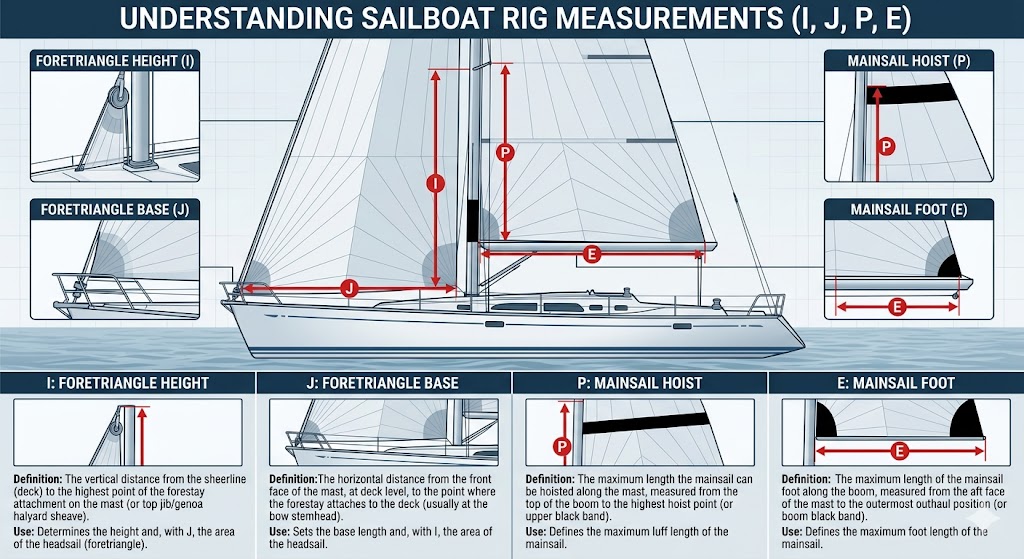
Rig Dimensions
I (Foretriangle Height) 50.92 ft / 15.52 m
J (Foretriangle Base) 14.67 ft / 4.47 m
P (Mainsail Luff) 44.83 ft / 13.66 m
E (Mainsail Foot) 15.67 ft / 4.78 m
SA Fore 373.50 ft² / 34.70 m²
SA Main 351.24 ft² / 32.63 m²
SA Total (100%) 724.74 ft² / 67.33 m²
Est. Forestay Length 52.99 ft / 16.15 m
Engine & Accommodations
Engine Make Westerbeke
Engine Type Diesel
Horsepower 42
Fuel Capacity 26 gals / 98 L
Water Capacity 102 gals / 386 L
Resources & Community
Find a Catalina 380 For Sale