Back to Search
Catalina 30
Designer: Frank Butler  ·  Builder: Catalina Yachts (Usa)  ·  First built: 1976
+ Add to Compare
📖
Buyer's Guide Available
Catalina 30 Buyer's Guide
History, what years to buy, common problems & live price data
Read →
Videos
Catalina 30
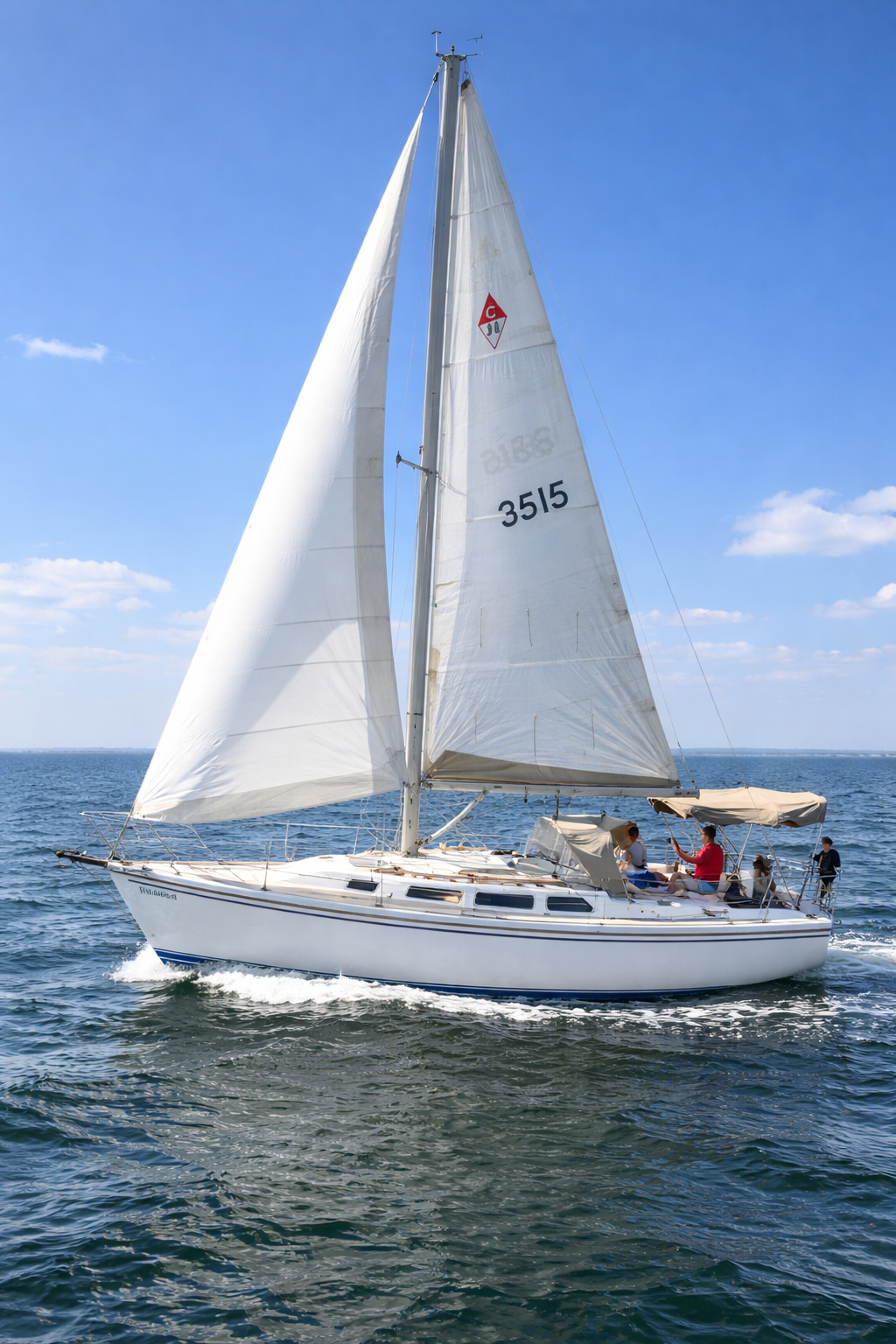
Photo: Ahunt / CC0
About the Catalina 30

First launched in 1976 and remaining in production until 2008, Frank Butler's Catalina 30 became one of America's most successful mid-size cruising sailboats, with over 6,400 hulls built during its impressive 32-year run. This popularity stems from Butler's thoughtful design that balances affordability, comfort, and solid sailing performance. The Catalina 30's moderate displacement of 10,200 pounds and generous beam of 10.83 feet create a stable, roomy platform ideal for coastal cruising and weekend adventures. With 446 square feet of sail area driving the masthead sloop rig, the boat offers respectable performance while remaining manageable for couples or small crews. The fin keel and spade rudder configuration provides good maneuverability and pointing ability. Butler designed the hull with a comfortable motion and predictable handling characteristics that inspire confidence in new sailors while still satisfying more experienced crews. The boat's construction quality and parts availability remain excellent thanks to Catalina Yachts' continued support. While primarily suited for coastal and protected water sailing, many owners have successfully completed longer passages, making the Catalina 30 a versatile choice for sailors seeking reliable performance without breaking the budget.

Featured in Keel Index Articles
Market Price Estimate Beta
$2,995 – $30,000
typical asking price
Median $15,900  ·  144 listings used (2 outliers excluded)
All listings
$2,995 – $30,000 144
Rate a listing price
$
About this estimate
  • Prices are based on recent asking prices from public listings — not actual sale prices, which are typically lower.
  • Condition is not factored in. A well-maintained boat with new sails and engine can be worth significantly more than a project boat of the same model.
  • Location affects price. Boats in landlocked states or areas with fewer buyers often sell for less than those on the coast.
  • Year of manufacture is not filtered. Older examples of this model will generally be priced lower than newer ones.
  • Included equipment varies widely. A boat with a full suite of electronics, dodger, and new standing rigging may command a large premium.
  • Outliers are automatically excluded using statistical filtering to improve accuracy, but some bad data may remain.
Core Dimensions
LOA (Length Overall) 29.92 ft / 9.12 m
LWL (Waterline Length) 25.00 ft / 7.62 m
Beam 10.83 ft / 3.30 m
Max Draft 5.25 ft / 1.60 m
Displacement 10,200.00 lb / 4,627 kg
Ballast 4,200.00 lb / 1,905 kg
Ballast Type Lead
Sail Area (Reported) 446.00 ft² / 41.43 m²
Headroom 6.25 ft / 1.91 m
Design & Construction
Hull Type Fin w/spade rudder
Rigging Type Masthead Sloop
Construction FG
Designer Frank Butler
Builder Catalina Yachts (USA)
First Built 1976
Last Built 2006
Number Built 6430
Associations Catalina 30/309 Association (IC30A)
Related Sailboats Catalina 30 Mkii
Owner Reviews

No owner reviews yet — be the first to share your experience with this boat.

Known Issues & What to Watch For
High Keel
The keel-to-hull joint is a known chronic problem on the Catalina 30. The cast iron fin keel is bolted through a shallow sump, and the joint frequently allows water intrusion, leading to rust staining, keel sump delamination, and in severe cases, keel wobble. Inspect the bilge sump carefully for rust streaks and soft fiberglass.
High Keel
Keel bolts are cast iron and prone to corrosion, particularly in boats that have sat in the water for extended periods. The interior bilge area around the keel bolt heads should be inspected for rust, weeping, and deterioration of the backing plates.
Medium Hull/Deck
The deck-to-hull joint on early Catalina 30s uses an external aluminum toerail that is through-bolted and serves as part of the joint. Bedding compound fails over time, allowing water intrusion along the entire hull-deck seam, often causing hidden delamination in the deck flange.
pre-1985 models
Medium Hull/Deck
The cockpit locker lids and the area around the chainplates are notorious for leaking on the Catalina 30. Chainplates are inboard-mounted on the bulkhead and the deck fittings frequently allow water below, leading to wet interior and potential bulkhead rot around the chainplate attachment points.
Medium Hull/Deck
Balsa core is used in the deck, and moisture intrusion around deck hardware — particularly stanchion bases, cleats, and the mast step — is a well-documented problem. Soft spots in the deck around these fittings indicate wet or deteriorated core.
High Rigging
The chainplates on the Catalina 30 are bolted to interior bulkheads rather than through-bolted to structural members in many configurations. The bulkheads can delaminate from the hull liner over time, compromising chainplate integrity. Inspect the interior bulkhead-to-liner bond at the chainplate attachment points.
Medium Rigging
The tabernacle-style mast step on deck (on sloop-rigged models) and the mast partner area are prone to cracking and stress fractures in the fiberglass deck around the base. Check for crazing or cracking in gelcoat around the mast boot area.
Medium Engine
Early Catalina 30s were fitted with the Universal Atomic 4 gasoline engine, which has a known history of carburetor problems, ethanol fuel compatibility issues, and raw water cooling corrosion. Many have been repowered with small diesel engines; confirm engine type and inspect raw water impeller housing for corrosion if still gasoline-powered.
pre-1980 models
Medium Engine
The engine compartment on the Catalina 30 is very tight, making access to the Universal or Westerbeke diesel difficult for routine maintenance. Improperly maintained raw water cooling systems and exhaust elbows are common on these boats due to access difficulty; the exhaust elbow in particular is prone to corrosion and failure.
Low Accommodations
The interior liner system used by Catalina creates hidden voids between the liner and the hull where water can collect unseen. Moisture trapped in these voids promotes mold and can be difficult to dry out; lifting or separating liner sections near the bilge and settees is a known problem on older boats.
High Hull/Deck
The rudder on the Catalina 30 uses a foam-cored fiberglass construction. Water intrusion into the rudder core through the lower pintle fitting or stress cracks leads to waterlogged or delaminated rudders, which can cause the rudder to fail structurally. Tap test the rudder and check for any movement at the pintle/gudgeon fittings.
Medium Electrical
Factory wiring on the Catalina 30 is often undersized by modern standards and routed through the same hidden liner voids that collect moisture. Corrosion at terminal connections and failed crimped terminals in the bilge area and behind the companionway panel are common findings on boats of this era.
pre-1990 models

Own or have surveyed a Catalina 30? Submit a known issue
Performance Ratios
SA/Displacement Sail Area to Displacement ratio measures how much sail power a boat has relative to its weight. Higher values mean more performance and speed.
Under 14 — Heavy cruiser, slow14–18 — Cruising sailboat18–22 — Cruiser/racerOver 22 — Performance racer
15.22
Ballast/Displacement Ballast to Displacement ratio shows what percentage of the boat's total weight is ballast. Higher values generally mean better initial stability and stiffer sail carrying.
30–35% — Typical cruiser35–45% — Stiff performance boatOver 45% — Racing oriented
41.18
Displacement/Length Displacement to Length ratio measures how heavy a boat is relative to its waterline length. Lower values mean a lighter, faster boat.
Under 100 — Ultralight racer100–200 — Light cruiser/racer200–300 — Moderate cruiser300–400 — Heavy cruiserOver 400 — Very heavy
291.43
Comfort Ratio Ted Brewer's Comfort Ratio predicts how comfortable a boat will feel in offshore conditions. Higher values mean a steadier, more comfortable motion in a seaway.
Under 20 — Uncomfortably rough20–30 — Acceptable coastal30–40 — Good offshore comfortOver 40 — Very comfortable offshore
24.93
Capsize Screening Formula The USHS Capsize Screening Formula estimates offshore capsize risk. Lower is safer — values under 2.0 are considered acceptable for offshore sailing.
Under 2.0 — Safe for offshore2.0–2.2 — Borderline offshoreOver 2.2 — Coastal use recommended
2
Hull Speed Hull Speed is the theoretical maximum speed of a displacement hull, calculated from waterline length. Most cruising sailboats reach this speed in moderate conditions. 6.70 kn
S# (Speed Number) The Speed Number (S#) is a quick performance index. Higher values indicate a faster, more powerful design relative to its size.
Under 3.0 — Slow cruiser3.0–5.0 — Average cruiser5.0–7.0 — Performance cruiserOver 7.0 — Racer
1.64
Pounds/Inch Immersion Pounds per Inch Immersion (PPI) tells you how much weight is needed to sink the boat one inch. Useful for calculating how additional gear and stores affect waterline. 967.42 pounds/inch
SA/Displacement (Calc) Calculated Sail Area to Displacement ratio using actual measured sail dimensions rather than reported values. More precise than the reported SA/Disp figure. 14.92
Rig Dimensions
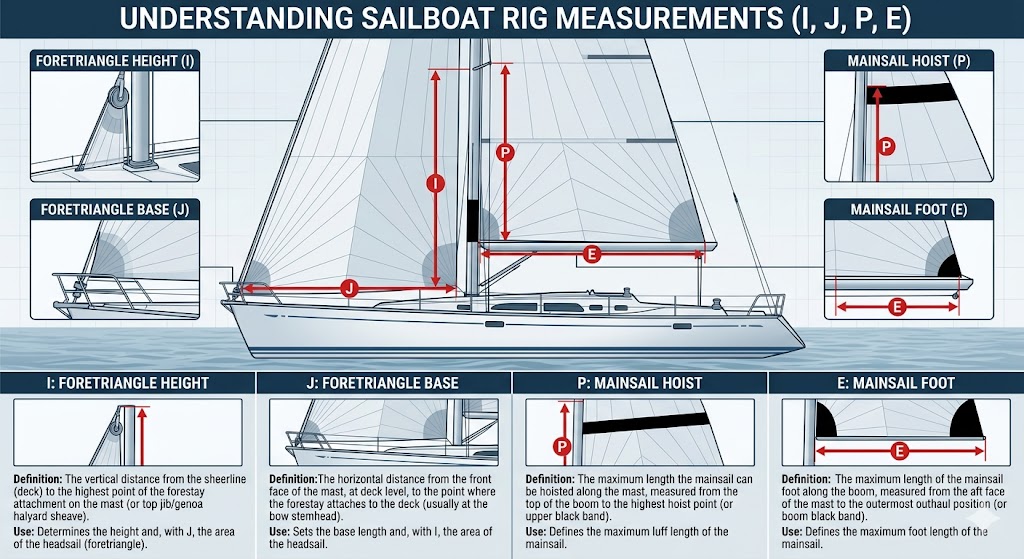
I (Foretriangle Height) 41.00 ft / 12.50 m
J (Foretriangle Base) 11.50 ft / 3.51 m
P (Mainsail Luff) 35.00 ft / 10.67 m
E (Mainsail Foot) 11.50 ft / 3.51 m
SA Fore 235.75 ft² / 21.90 m²
SA Main 201.25 ft² / 18.70 m²
SA Total (100%) 437.00 ft² / 40.60 m²
Est. Forestay Length 42.58 ft / 12.98 m
Mast Height (DWL) 45.92 ft / 14.00 m
Engine & Accommodations
Engine Make Var.
Engine Type Var.
Fuel Capacity 21 gals / 79 L
Water Capacity 43 gals / 163 L
Resources & Community
📖
Catalina 30 Buyer's Guide History, versions, what to inspect, and real price data from active listings
Read Guide →
Find a Catalina 30 For Sale