Back to Search
Catalina 270
Designer: Frank Butler  ·  First built: 1992
+ Add to Compare
Videos
Catalina 270
About the Catalina 270

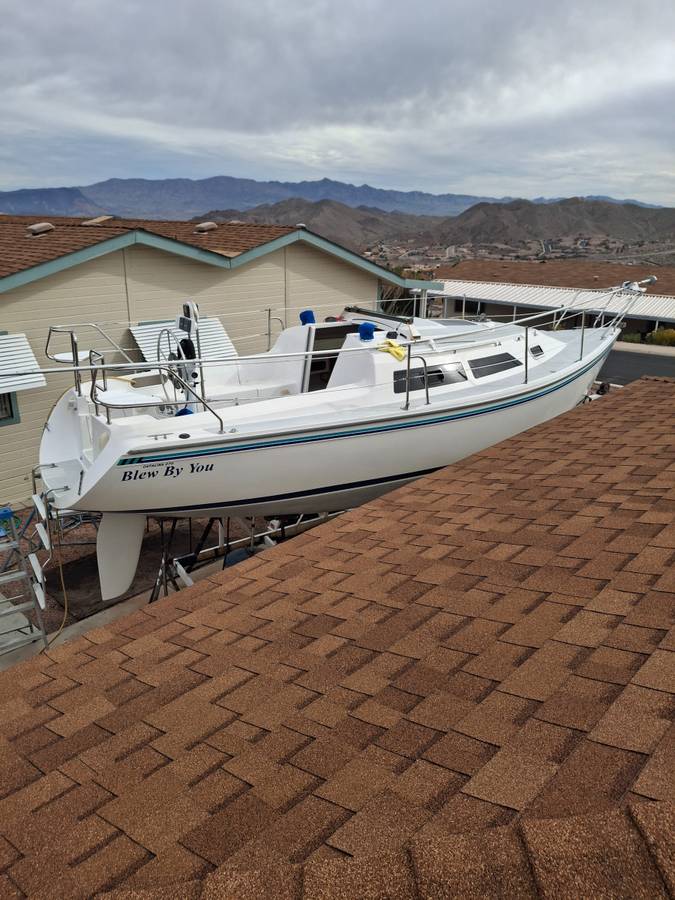
Launched in 1994, this compact cruiser from Catalina Yachts represents the builder's commitment to creating affordable, well-built sailboats for weekend adventurers and coastal cruisers. The 270 carries forward Catalina's reputation for producing boats that balance sailing performance with comfortable accommodations, making it an attractive option for sailors transitioning from smaller boats or those seeking a manageable cruising platform. Built with Catalina's trademark attention to practical sailing needs, the 270 features a moderate fin keel and spade rudder configuration that provides responsive handling while maintaining stability. The boat's proportions suggest it's well-suited for coastal cruising and protected water sailing, offering enough interior volume for comfortable weekend trips or extended seasonal cruising. Like other Catalina designs from this era, the 270 emphasizes user-friendly sailing characteristics over racing performance. The cockpit layout and deck hardware reflect practical considerations for shorthanded sailing, while the cabin provides essential amenities without unnecessary complexity. This approach has made Catalina boats popular among sailors who prioritize reliability and ease of maintenance over cutting-edge design features, positioning the 270 as a solid choice for recreational sailing.

Market Price Estimate Beta
Small sample size. This estimate is based on fewer than 5 listings and may not be representative of the true market. Use with caution.
$29,500 – $29,500
typical asking price
Median $29,500  ·  3 listings used
All listings
$29,500 – $29,500 3
Rate a listing price
$
About this estimate
  • Prices are based on recent asking prices from public listings — not actual sale prices, which are typically lower.
  • Condition is not factored in. A well-maintained boat with new sails and engine can be worth significantly more than a project boat of the same model.
  • Location affects price. Boats in landlocked states or areas with fewer buyers often sell for less than those on the coast.
  • Year of manufacture is not filtered. Older examples of this model will generally be priced lower than newer ones.
  • Included equipment varies widely. A boat with a full suite of electronics, dodger, and new standing rigging may command a large premium.
  • Outliers are automatically excluded using statistical filtering to improve accuracy, but some bad data may remain.
Core Dimensions
LOA (Length Overall) 27.00 ft / 8.23 m
LWL (Waterline Length) 23.50 ft / 7.16 m
Beam 9.75 ft / 2.97 m
Max Draft 4.17 ft / 1.27 m
Displacement 6,200 lb / 2,812 kg
Ballast 2,500 lb / 1,134 kg
Sail Area (Reported) 332 ft² / 30.84 m²
Design & Construction
Hull Type Fin w/spade rudder
Rigging Type Masthead Sloop
Construction FG
Designer Frank Butler
First Built 1992
Last Built 2005
Number Built 2200
Owner Reviews

No owner reviews yet — be the first to share your experience with this boat.

Known Issues & What to Watch For
Medium Hull/Deck
The deck-to-hull joint on the Catalina 270 uses an outward-turned flange held with through-bolts and sealant. This joint is known to leak, particularly along the bow and stern quarters, leading to water intrusion into the liner cavity that is difficult to dry out.
High Hull/Deck
The balsa-cored deck sections, particularly around deck hardware, chainplates, and stanchion bases, are prone to water intrusion and core rot when fastener bedding fails. Soft spots on deck are common on older examples.
High Keel
The fin keel attachment on early 270s used a relatively shallow keel sump. Keel bolt corrosion and weeping at the keel-to-hull joint are reported issues; inspect carefully for rust staining or movement at the joint.
1992–1998 models
High Rigging
The chainplate knees are glassed to the hull liner rather than the hull shell on some models, which can allow flex and eventual failure. Inspect the interior chainplate attachment area for cracking in the surrounding fiberglass tabbing.
Medium Hull/Deck
The spade rudder bearing housing is known to develop slop over time due to wear in the upper and lower bushings. Significant rudder play is common on higher-hour boats and should be inspected closely.
Medium Accommodations
The raw water intake and through-hull fittings on the 270 are located in areas that are difficult to access behind the liner, making routine inspection and seacock exercise challenging. Seized or deteriorated seacocks are frequently found.
Medium Engine
The Universal M-18 or Yanmar 1GM10 engines fitted in the 270 are installed in a tight, poorly ventilated space under the companionway steps. Overheating due to restricted raw water flow and impeller neglect is a common reported problem.
Medium Hull/Deck
The tabbing that bonds the interior liner to the hull shell is relatively light on Catalina production boats of this era. Delamination of the liner from the hull is sometimes found in the bow and stern sections.

Own or have surveyed a Catalina 270? Submit a known issue

Performance Ratios
PHRF Rating PHRF (Performance Handicap Racing Fleet) is a national racing handicap measured in seconds per nautical mile. Lower values indicate faster boats. Ratings are sourced from US Sailing's national database (median across 60+ regional fleets).
Under 0 — Ultralight racer0–90 — Performance racer90–150 — Cruiser/racer150–210 — Typical cruiserOver 210 — Heavy/slow cruiser
198
SA/Displacement Sail Area to Displacement ratio measures how much sail power a boat has relative to its weight. Higher values mean more performance and speed.
Under 14 — Heavy cruiser, slow14–18 — Cruising sailboat18–22 — Cruiser/racerOver 22 — Performance racer
15.72
Ballast/Displacement Ballast to Displacement ratio shows what percentage of the boat's total weight is ballast. Higher values generally mean better initial stability and stiffer sail carrying.
30–35% — Typical cruiser35–45% — Stiff performance boatOver 45% — Racing oriented
40.32
Displacement/Length Displacement to Length ratio measures how heavy a boat is relative to its waterline length. Lower values mean a lighter, faster boat.
Under 100 — Ultralight racer100–200 — Light cruiser/racer200–300 — Moderate cruiser300–400 — Heavy cruiserOver 400 — Very heavy
213.28
Comfort Ratio Ted Brewer's Comfort Ratio predicts how comfortable a boat will feel in offshore conditions. Higher values mean a steadier, more comfortable motion in a seaway.
Under 20 — Uncomfortably rough20–30 — Acceptable coastal30–40 — Good offshore comfortOver 40 — Very comfortable offshore
18.67
Capsize Screening Formula The USHS Capsize Screening Formula estimates offshore capsize risk. Lower is safer — values under 2.0 are considered acceptable for offshore sailing.
Under 2.0 — Safe for offshore2.0–2.2 — Borderline offshoreOver 2.2 — Coastal use recommended
2.13
Hull Speed Hull Speed is the theoretical maximum speed of a displacement hull, calculated from waterline length. Most cruising sailboats reach this speed in moderate conditions. 6.5 kn
Pounds/Inch Immersion Pounds per Inch Immersion (PPI) tells you how much weight is needed to sink the boat one inch. Useful for calculating how additional gear and stores affect waterline. 4.91 pounds/inch
Resources & Community
Find a Catalina 270 For Sale