Back to Search
Catalac
Designer: J. Winterbotom/Tom & Mary Lack  ·  Builder: Tom Lack Catamarans (Uk)  ·  First built: 1971
+ Add to Compare
About the Catalac

Developed during the 1960s catamaran boom, Catalac sailboats earned recognition as pioneering production multihulls that helped establish catamarans as viable cruising vessels. These British-built boats emerged from the drawing boards of designers who understood the growing demand for spacious, stable sailing platforms that could offer comfortable accommodations without sacrificing seaworthiness. Catalac catamarans became known for their solid construction and practical approach to multihull sailing. The design philosophy emphasized stability and interior volume over outright speed, making them particularly appealing to cruising sailors who valued comfort and safety. Their wide beam provided exceptional stability and allowed for generous accommodations that rivaled much larger monohulls. These boats proved well-suited for coastal cruising and extended voyaging, with many examples completing ocean passages and serving as liveaboard homes. The shallow draft characteristic of the design opened up cruising grounds inaccessible to deeper-keeled vessels, while the twin-hull configuration offered redundancy in steering and engine systems. Though production ceased years ago, Catalac sailboats maintain a loyal following among multihull enthusiasts who appreciate their robust build quality and proven blue-water capabilities. They represent an important chapter in the evolution of production catamarans.

Core Dimensions
LOA (Length Overall) 29.25 ft / 8.92 m
LWL (Waterline Length) 25.92 ft / 7.90 m
Beam 14.00 ft / 4.27 m
Max Draft 2.25 ft / 0.69 m
Displacement 8,000.00 lb / 3,629 kg
Design & Construction
Hull Type Catamaran (no boards/asym.)
Rigging Type Masthead Sloop
Construction FG
Designer J. Winterbotom/Tom & Mary Lack
Builder Tom Lack Catamarans (UK)
First Built 1971
Owner Reviews

No owner reviews yet — be the first to share your experience with this boat.
Performance Ratios
Displacement/Length Displacement to Length ratio measures how heavy a boat is relative to its waterline length. Lower values mean a lighter, faster boat.
Under 100 — Ultralight racer100–200 — Light cruiser/racer200–300 — Moderate cruiser300–400 — Heavy cruiserOver 400 — Very heavy
205.09
Comfort Ratio Ted Brewer's Comfort Ratio predicts how comfortable a boat will feel in offshore conditions. Higher values mean a steadier, more comfortable motion in a seaway.
Under 20 — Uncomfortably rough20–30 — Acceptable coastal30–40 — Good offshore comfortOver 40 — Very comfortable offshore
13.56
Capsize Screening Formula The USHS Capsize Screening Formula estimates offshore capsize risk. Lower is safer — values under 2.0 are considered acceptable for offshore sailing.
Under 2.0 — Safe for offshore2.0–2.2 — Borderline offshoreOver 2.2 — Coastal use recommended
2.8
Hull Speed Hull Speed is the theoretical maximum speed of a displacement hull, calculated from waterline length. Most cruising sailboats reach this speed in moderate conditions. 6.82 kn
Pounds/Inch Immersion Pounds per Inch Immersion (PPI) tells you how much weight is needed to sink the boat one inch. Useful for calculating how additional gear and stores affect waterline. 7.78 pounds/inch
Rig Dimensions
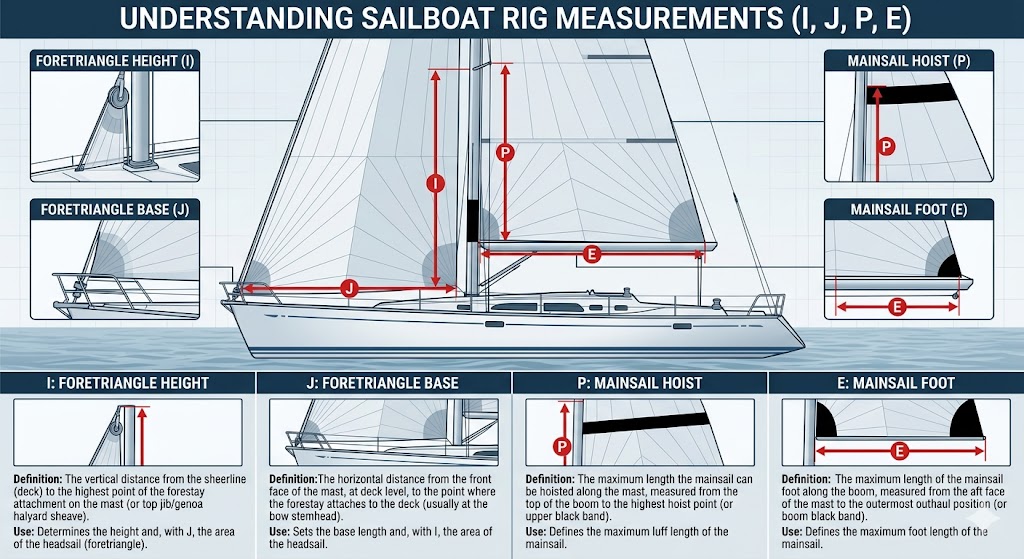
I (Foretriangle Height) 18.06
P (Mainsail Luff) 450.00 ft² / 41.81 m²
E (Mainsail Foot) 205.09
Find a Catalac For Sale