Back to Search
Cape Dory 31
Designer: Carl Alberg  ·  Builder: Cape Dory Yachts (Usa)  ·  First built: 1983
+ Add to Compare
Videos
About the Cape Dory 31

Designed by the legendary Carl Alberg, this classic cruising sailboat represents the pinnacle of Cape Dory's traditional yacht-building philosophy during its brief three-year production run from 1983 to 1985. With only 89 hulls built, the Cape Dory 31 has become a sought-after vessel among sailors who appreciate timeless design and solid construction. The boat's long keel configuration and substantial displacement of 11,500 pounds create exceptional directional stability and seakindly motion in rough conditions, making it ideally suited for serious coastal cruising and offshore passages. The generous ballast-to-displacement ratio provides reassuring stability, while the moderate sail area keeps the boat manageable in heavy weather. Alberg's signature design elements shine through in the graceful sheerline and well-proportioned hull, delivering both aesthetic appeal and practical performance. The cutter rig configuration offers excellent sail-handling versatility, particularly valuable when sailing short-handed or in challenging conditions. With a comfort ratio of 33.34, this boat prioritizes seaworthiness over speed, appealing to cruisers who value safety and comfort during extended passages. The Cape Dory 31 continues Alberg's reputation for creating boats that inspire confidence in their owners, whether coastal hopping or venturing offshore.

Market Price Estimate Beta
$24,500 – $45,000
typical asking price
Median $33,831  ·  5 listings used
All listings
$24,500 – $45,000 5
Rate a listing price
$
About this estimate
  • Prices are based on recent asking prices from public listings — not actual sale prices, which are typically lower.
  • Condition is not factored in. A well-maintained boat with new sails and engine can be worth significantly more than a project boat of the same model.
  • Location affects price. Boats in landlocked states or areas with fewer buyers often sell for less than those on the coast.
  • Year of manufacture is not filtered. Older examples of this model will generally be priced lower than newer ones.
  • Included equipment varies widely. A boat with a full suite of electronics, dodger, and new standing rigging may command a large premium.
  • Outliers are automatically excluded using statistical filtering to improve accuracy, but some bad data may remain.
Core Dimensions
LOA (Length Overall) 31.33 ft / 9.55 m
LWL (Waterline Length) 23.25 ft / 7.09 m
Beam 9.75 ft / 2.97 m
Max Draft 4.75 ft / 1.45 m
Displacement 11,500.00 lb / 5,216 kg
Ballast 4,350.00 lb / 1,973 kg
Sail Area (Reported) 504.00 ft² / 46.82 m²
Design & Construction
Hull Type Long Keel
Rigging Type Cutter
Construction FG
Designer Carl Alberg
Builder Cape Dory Yachts (USA)
First Built 1983
Last Built 1985
Number Built 89
Associations Cape Dory Sailboat Owners Association
Owner Reviews

No owner reviews yet — be the first to share your experience with this boat.

Known Issues & What to Watch For
Medium Hull/Deck
The deck hardware on Cape Dory 31s was typically through-bolted through cored deck sections. The balsa core around chainplates and stanchion bases is prone to water intrusion and rot, often hidden beneath hardware. Careful probing and moisture metering around all deck fittings is essential.
Medium Hull/Deck
The hull-to-deck joint on Cape Dory vessels of this era uses an outward-turning flange joined with adhesive sealant and bolted, then covered by an aluminum toerail. This joint can allow water intrusion if the sealant has dried out or if the toerail fasteners have loosened, leading to delamination in the joint area.
High Keel
The full-length keel on the CD31 uses keel bolts that are difficult to access and inspect from the interior. Rust weeping and soft or wet fiberglass at the keel-to-hull joint is a known issue and should be probed carefully. Suspect keelbolts should be surveyed with ultrasound or extracted for inspection.
High Rigging
The chainplate knees on Cape Dory 31s are glassed to the hull interior. Over time, the laminate bonding the chainplate knees can develop stress cracks or partial delamination due to rig loads, particularly on boats that have been sailed hard. Inspect the bonding tabbing carefully from below.
Medium Hull/Deck
The portlight frames on Cape Dory 31s of this production era are bronze, which is durable, but the bedding compound dries out and leaks are common. Water intrusion from portlights into the cabin liner and surrounding joinery is a frequent finding on these boats.
Medium Accommodations
The teak interior joinery Cape Dory used in this period is high quality but the varnish and wood can deteriorate significantly if the boat has been stored with chronic portlight or deck leaks. Check underneath settees and around the base of the mast partners for soft or discolored wood indicating water damage.
Medium Engine
The CD31 was commonly fitted with a small Universal or Westerbeke diesel engine in a tight engine compartment that limits access for maintenance. Heat buildup and poor ventilation in this space can accelerate raw water impeller wear and heat exchanger corrosion. Verify full service history and inspect cooling system components carefully.
High Hull/Deck
The rudder on the Cape Dory 31 is a full skeg-hung design with an internal metal armature. Rudders of this era can develop voids or water ingress around the stock where it exits the blade, leading to internal corrosion of the armature that is not visible externally until structural failure is advanced.

Own or have surveyed a Cape Dory 31? Submit a known issue
Performance Ratios
PHRF Rating PHRF (Performance Handicap Racing Fleet) is a national racing handicap measured in seconds per nautical mile. Lower values indicate faster boats. Ratings are sourced from US Sailing's national database (median across 60+ regional fleets).
Under 0 — Ultralight racer0–90 — Performance racer90–150 — Cruiser/racer150–210 — Typical cruiserOver 210 — Heavy/slow cruiser
198
SA/Displacement Sail Area to Displacement ratio measures how much sail power a boat has relative to its weight. Higher values mean more performance and speed.
Under 14 — Heavy cruiser, slow14–18 — Cruising sailboat18–22 — Cruiser/racerOver 22 — Performance racer
15.88
Ballast/Displacement Ballast to Displacement ratio shows what percentage of the boat's total weight is ballast. Higher values generally mean better initial stability and stiffer sail carrying.
30–35% — Typical cruiser35–45% — Stiff performance boatOver 45% — Racing oriented
37.83
Displacement/Length Displacement to Length ratio measures how heavy a boat is relative to its waterline length. Lower values mean a lighter, faster boat.
Under 100 — Ultralight racer100–200 — Light cruiser/racer200–300 — Moderate cruiser300–400 — Heavy cruiserOver 400 — Very heavy
408.49
Comfort Ratio Ted Brewer's Comfort Ratio predicts how comfortable a boat will feel in offshore conditions. Higher values mean a steadier, more comfortable motion in a seaway.
Under 20 — Uncomfortably rough20–30 — Acceptable coastal30–40 — Good offshore comfortOver 40 — Very comfortable offshore
33.34
Capsize Screening Formula The USHS Capsize Screening Formula estimates offshore capsize risk. Lower is safer — values under 2.0 are considered acceptable for offshore sailing.
Under 2.0 — Safe for offshore2.0–2.2 — Borderline offshoreOver 2.2 — Coastal use recommended
1.73
Hull Speed Hull Speed is the theoretical maximum speed of a displacement hull, calculated from waterline length. Most cruising sailboats reach this speed in moderate conditions. 6.46 kn
S# (Speed Number) The Speed Number (S#) is a quick performance index. Higher values indicate a faster, more powerful design relative to its size.
Under 3.0 — Slow cruiser3.0–5.0 — Average cruiser5.0–7.0 — Performance cruiserOver 7.0 — Racer
1.03
Pounds/Inch Immersion Pounds per Inch Immersion (PPI) tells you how much weight is needed to sink the boat one inch. Useful for calculating how additional gear and stores affect waterline. 809.98 pounds/inch
SA/Displacement (Calc) Calculated Sail Area to Displacement ratio using actual measured sail dimensions rather than reported values. More precise than the reported SA/Disp figure. 15.89
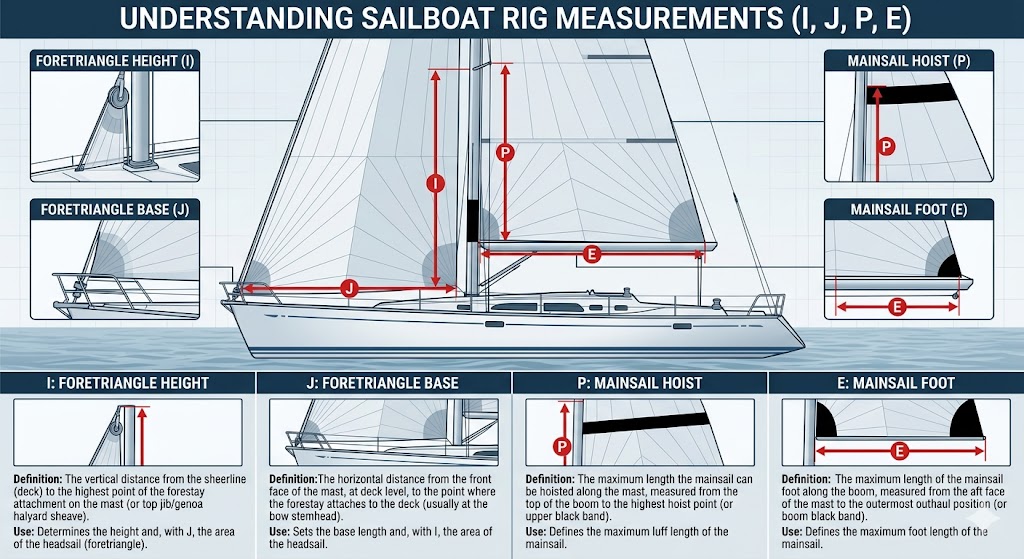
Rig Dimensions
I (Foretriangle Height) 41.00 ft / 12.50 m
J (Foretriangle Base) 13.50 ft / 4.11 m
P (Mainsail Luff) 35.00 ft / 10.67 m
E (Mainsail Foot) 13.00 ft / 3.96 m
SA Fore 276.75 ft² / 25.71 m²
SA Main 227.50 ft² / 21.14 m²
SA Total (100%) 504.25 ft² / 46.85 m²
Est. Forestay Length 43.17 ft / 13.16 m
Find a Cape Dory 31 For Sale