Back to Search
Cape Breton Jeanneau
Designer: Michel Dufour  ·  Builder: Jeanneau  ·  First built: 1975
+ Add to Compare
About the Cape Breton Jeanneau

With limited specifications available, this Jeanneau model represents part of the French builder's diverse sailing yacht lineup, though detailed information about the Cape Breton variant remains scarce in readily accessible sources. Jeanneau's reputation for producing well-built, moderately priced cruising sailboats suggests this model likely follows the company's established design philosophy of balancing performance with comfort and practicality. Given Jeanneau's typical approach to yacht design, the Cape Breton would presumably be suited for coastal cruising and perhaps light offshore passages, featuring the builder's characteristic emphasis on spacious interiors and user-friendly sailing characteristics. French yacht builders traditionally prioritize livability and ease of handling, making their boats appealing to both experienced sailors and those newer to the sport. Without comprehensive specifications, potential buyers should seek additional documentation from Jeanneau archives, yacht brokers familiar with this model, or existing owners who can provide firsthand insights into the boat's sailing characteristics, construction quality, and overall suitability for intended use. The scarcity of available information makes thorough research particularly important for anyone considering this model.

Core Dimensions
LOA (Length Overall) 29.53 ft / 9.00 m
LWL (Waterline Length) 25.59 ft / 7.80 m
Beam 10.33 ft / 3.15 m
Max Draft 4.92 ft / 1.50 m
Displacement 7,716 lb / 3,500 kg
Ballast 2,756 lb / 1,250 kg
Sail Area (Reported) 398 ft² / 36.97 m²
Design & Construction
Hull Type Fin w/spade rudder
Rigging Type Masthead Sloop
Construction FG
Designer Michel Dufour
Builder Jeanneau
First Built 1975
Last Built 1981
Owner Reviews

No owner reviews yet — be the first to share your experience with this boat.
Performance Ratios
SA/Displacement Sail Area to Displacement ratio measures how much sail power a boat has relative to its weight. Higher values mean more performance and speed.
Under 14 — Heavy cruiser, slow14–18 — Cruising sailboat18–22 — Cruiser/racerOver 22 — Performance racer
16.28
Ballast/Displacement Ballast to Displacement ratio shows what percentage of the boat's total weight is ballast. Higher values generally mean better initial stability and stiffer sail carrying.
30–35% — Typical cruiser35–45% — Stiff performance boatOver 45% — Racing oriented
35.72
Displacement/Length Displacement to Length ratio measures how heavy a boat is relative to its waterline length. Lower values mean a lighter, faster boat.
Under 100 — Ultralight racer100–200 — Light cruiser/racer200–300 — Moderate cruiser300–400 — Heavy cruiserOver 400 — Very heavy
205.56
Pounds/Inch Immersion Pounds per Inch Immersion (PPI) tells you how much weight is needed to sink the boat one inch. Useful for calculating how additional gear and stores affect waterline. 5.66 pounds/inch
Rig Dimensions
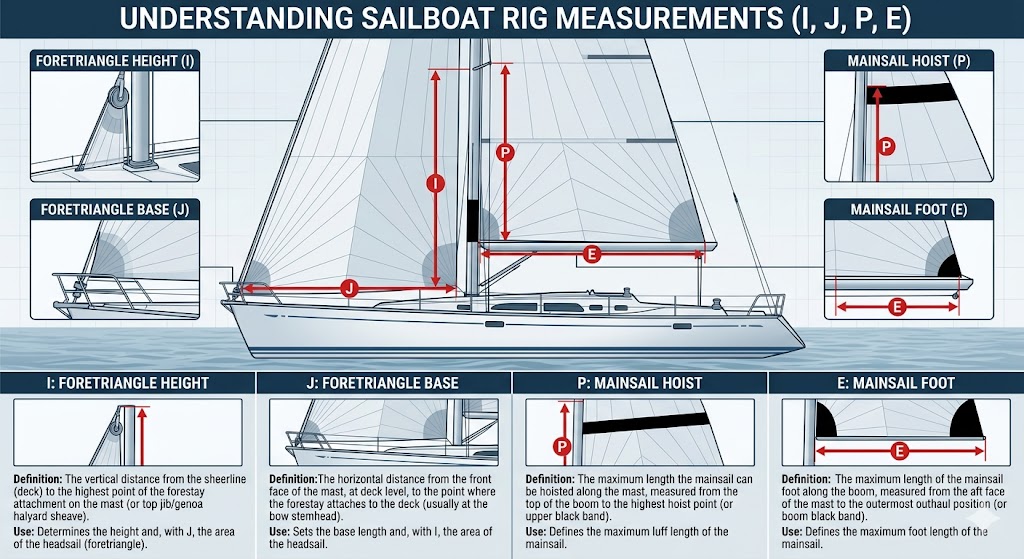
I (Foretriangle Height) 0.98 ft / 0.30 m
P (Mainsail Luff) 107.00 ft² / 9.94 m²
E (Mainsail Foot) Renault
Find a Cape Breton Jeanneau For Sale