Back to Search
Cal 30
Designer: Lapworth  ·  Builder: Jensen Marine  ·  First built: 1961
+ Add to Compare
Videos
About the Cal 30

Built during the height of the fiberglass revolution, this California-designed sailboat emerged from an era when West Coast builders were redefining what recreational sailing could be. Cal Yachts developed a reputation for creating affordable, well-built vessels that appealed to both racing enthusiasts and weekend cruisers seeking reliable performance. The Cal 30 embodies the classic design philosophy that made the brand famous—a balanced combination of speed and comfort that doesn't sacrifice seaworthiness for performance. Her hull lines reflect the influence of racing yacht design, yet she maintains enough interior volume and stability to serve admirably as a coastal cruiser. This versatility made her particularly popular among sailors who wanted one boat capable of handling both competitive sailing and family adventures. Like many boats from this builder, the Cal 30 gained a following for her solid construction and straightforward sailing characteristics. She's well-suited for coastal cruising, club racing, and sailors looking to develop their skills on a forgiving yet responsive platform. The design represents an era when sailboat manufacturers successfully bridged the gap between pure racing machines and heavy cruising boats, creating vessels that remain relevant decades after their introduction.

Core Dimensions
LOA (Length Overall) 30.00 ft / 9.14 m
LWL (Waterline Length) 24.50 ft / 7.47 m
Beam 10.00 ft / 3.05 m
Max Draft 4.50 ft / 1.37 m
Displacement 9,600.00 lb / 4,354 kg
Ballast 3,500.00 lb / 1,588 kg
Sail Area (Reported) 420.00 ft² / 39.02 m²
Design & Construction
Hull Type Fin Keel
Rigging Type Masthead Sloop
Construction FG
Designer Lapworth
Builder Jensen Marine
First Built 1961
Last Built 1967
Owner Reviews

No owner reviews yet — be the first to share your experience with this boat.

Known Issues & What to Watch For
Medium Hull/Deck
Early Jensen Marine CAL 30 hulls used relatively thin fiberglass layup schedules by modern standards, and stress cracks around the chainplates and shroud bases are common on aging examples. These should be investigated for underlying delamination rather than dismissed as cosmetic.
Medium Hull/Deck
The deck-to-hull joint on early CAL 30s was an outward-turned flange bonded and through-bolted, but sealant failure over 50+ years is nearly universal. Water intrusion at this joint can migrate into balsa or plywood deck core material used in the cockpit and side decks.
High Hull/Deck
The CAL 30 used balsa core in portions of the deck, and decades of water intrusion through hardware fasteners and the deck-to-hull joint commonly results in soft, saturated, or rotted core, particularly around stanchion bases and winch pads.
High Keel
The external lead keel is attached with steel keel bolts that are prone to corrosion and weeping rust stains in the bilge. Many original keel bolts are now 50–60 years old and should be professionally assessed; replacement is often recommended.
Medium Keel
The keel sump and bilge area of the CAL 30 is shallow and narrow, making full inspection of keel bolt nuts and backing plates difficult. Corrosion at the keel-to-hull interface is frequently obscured by layered paint or old fiberglass repairs.
High Rigging
The chainplate design on the CAL 30 runs through the deck and is bolted to the inner hull, but the deck penetrations are a chronic source of leaks. Many boats show rot in the wooden backing blocks behind the chainplates and corrosion of the chainplates themselves after decades of saltwater exposure.
Medium Accommodations
Teak and mahogany interior joinery, while attractive, is now 50–60 years old and commonly shows water damage, warping, or delamination from deck leaks above. Plywood bulkheads used as structural members should be checked for delamination, as they also serve as compression posts for the mast.
Medium Engine
Original CAL 30s were commonly fitted with Universal Atomic 4 gasoline engines, which are now very aged and often suffer from worn carburetors, deteriorated fuel lines, and obsolete parts availability. Many have been replaced with small diesel conversions of varying quality; verify the installation meets ABYC standards.
High Hull/Deck
The rudder on the CAL 30 is a fiberglass shell over a metal armature; the internal metal post and structure is susceptible to corrosion and can allow water intrusion into the rudder, leading to delamination, weight gain, and potential structural failure of the rudder blade.

Own or have surveyed a Cal 30? Submit a known issue
Performance Ratios
PHRF Rating PHRF (Performance Handicap Racing Fleet) is a national racing handicap measured in seconds per nautical mile. Lower values indicate faster boats. Ratings are sourced from US Sailing's national database (median across 60+ regional fleets).
Under 0 — Ultralight racer0–90 — Performance racer90–150 — Cruiser/racer150–210 — Typical cruiserOver 210 — Heavy/slow cruiser
183
SA/Displacement Sail Area to Displacement ratio measures how much sail power a boat has relative to its weight. Higher values mean more performance and speed.
Under 14 — Heavy cruiser, slow14–18 — Cruising sailboat18–22 — Cruiser/racerOver 22 — Performance racer
14.93
Comfort Ratio Ted Brewer's Comfort Ratio predicts how comfortable a boat will feel in offshore conditions. Higher values mean a steadier, more comfortable motion in a seaway.
Under 20 — Uncomfortably rough20–30 — Acceptable coastal30–40 — Good offshore comfortOver 40 — Very comfortable offshore
26.42
Capsize Screening Formula The USHS Capsize Screening Formula estimates offshore capsize risk. Lower is safer — values under 2.0 are considered acceptable for offshore sailing.
Under 2.0 — Safe for offshore2.0–2.2 — Borderline offshoreOver 2.2 — Coastal use recommended
1.89
Hull Speed Hull Speed is the theoretical maximum speed of a displacement hull, calculated from waterline length. Most cruising sailboats reach this speed in moderate conditions. 6.63
S# (Speed Number) The Speed Number (S#) is a quick performance index. Higher values indicate a faster, more powerful design relative to its size.
Under 3.0 — Slow cruiser3.0–5.0 — Average cruiser5.0–7.0 — Performance cruiserOver 7.0 — Racer
1.64
Pounds/Inch Immersion Pounds per Inch Immersion (PPI) tells you how much weight is needed to sink the boat one inch. Useful for calculating how additional gear and stores affect waterline. 875.41
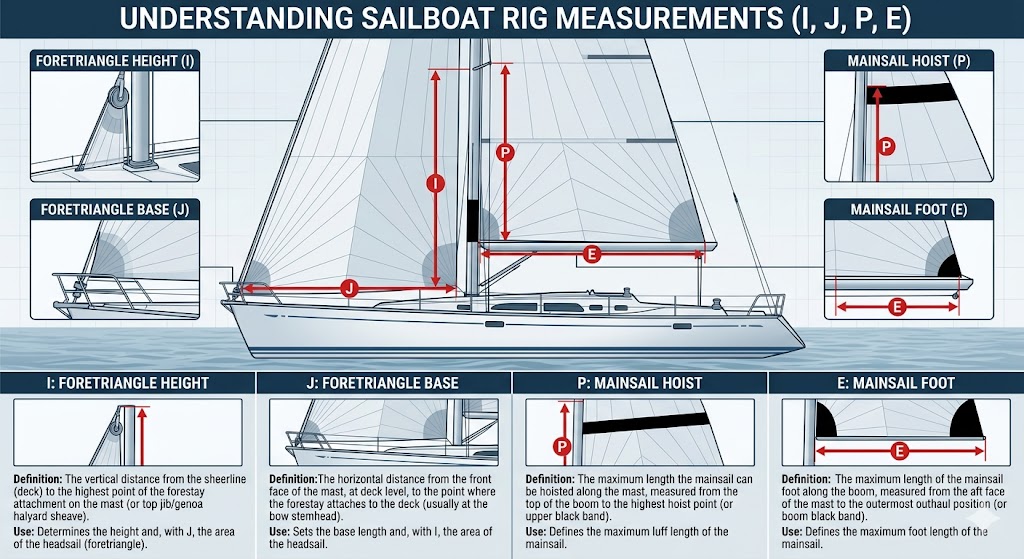
Rig Dimensions
I (Foretriangle Height) 35.0
J (Foretriangle Base) 12.0
P (Mainsail Luff) 30.0
E (Mainsail Foot) 14.0
SA Fore 210.0
SA Main 210.0
How It Compares

vs. Arpege 30 Dufour, Cape Cod 30, Capri 30 Chris Craft

This boat Similar boats
Dimensions
LOA
Cal 30 ★
30.0 ft
Arpege 30 Dufour
30.0 ft
Cape Cod 30
30.0 ft
Capri 30 Chris Craft
30.0 ft
LWL
Cal 30 ★
24.5 ft
Arpege 30 Dufour
22.0 ft
Cape Cod 30
23.2 ft
Capri 30 Chris Craft
25.0 ft
Beam
Cal 30 ★
10.0 ft
Arpege 30 Dufour
9.9 ft
Cape Cod 30
9.0 ft
Capri 30 Chris Craft
9.7 ft
Displacement
Cal 30 ★
9 lbs
Arpege 30 Dufour
7 lbs
Cape Cod 30
7 lbs
Capri 30 Chris Craft
11 lbs
Ballast
Cal 30 ★
3 lbs
Arpege 30 Dufour
3 lbs
Cape Cod 30
Capri 30 Chris Craft
4 lbs
Sail Area
Cal 30 ★
420 sq ft
Arpege 30 Dufour
382 sq ft
Cape Cod 30
438 sq ft
Capri 30 Chris Craft
474 sq ft
Performance
PHRF Rating (lower = faster)
Cal 30 ★
183 s/nm
Arpege 30 Dufour
Cape Cod 30
204 s/nm
Capri 30 Chris Craft
SA / Displacement (higher = more powerful)
Cal 30 ★
14.9
Arpege 30 Dufour
15.7
Cape Cod 30
19.2
Capri 30 Chris Craft
14.7
Comfort Ratio (higher = more comfortable offshore)
Cal 30 ★
26.4
Arpege 30 Dufour
23.0
Cape Cod 30
23.0
Capri 30 Chris Craft
33.3
Capsize Screening (lower = safer)
Cal 30 ★
1.89
Arpege 30 Dufour
2.01
Cape Cod 30
1.88
Capri 30 Chris Craft
1.70
Hull Speed
Cal 30 ★
6.6 kts
Arpege 30 Dufour
6.3 kts
Cape Cod 30
6.5 kts
Capri 30 Chris Craft
6.7 kts
Speed Number (higher = faster)
Cal 30 ★
1.6
Arpege 30 Dufour
1.5
Cape Cod 30
2.4
Capri 30 Chris Craft
1.3
Find a Cal 30 For Sale