Back to Search
Bristol 34
Designer: Halsey C. Herreshoff  ·  Builder: Bristol Yachts Inc. (Usa)  ·  First built: 1970
+ Add to Compare
Videos
About the Bristol 34

Designed by renowned naval architect Halsey C. Herreshoff and built by Bristol Yachts from 1970 to 1978, this 34-footer represents classic American yacht design from sailing's golden era. With only 70 hulls produced during its eight-year production run, the Bristol 34 has become a sought-after vessel among sailors who appreciate traditional craftsmanship and thoughtful engineering. The boat's moderate displacement of 11,500 pounds and substantial ballast ratio provide excellent stability and seaworthiness, making it well-suited for coastal cruising and occasional offshore passages. The fin keel with rudder on skeg configuration offers a good balance between performance and directional stability, while the masthead sloop rig delivers versatile sailing characteristics across varying wind conditions. With a comfort ratio of 27.24, this Bristol strikes an appealing middle ground between performance and livability. The low capsize screening value of 1.86 indicates exceptional stability and ocean-going capability, reflecting Herreshoff's emphasis on safety and seaworthiness. Hull speed calculations suggest comfortable passage-making speeds, while the sail area to displacement ratio indicates responsive performance without being overly demanding to handle. This Bristol 34 appeals to sailors seeking a well-built, traditional cruiser capable of extended coastal voyaging with occasional offshore adventures.

Core Dimensions
LOA (Length Overall) 34.25 ft / 10.44 m
LWL (Waterline Length) 26.00 ft / 7.92 m
Beam 10.50 ft / 3.20 m
Max Draft 5.50 ft / 1.68 m
Displacement 11,500.00 lb / 5,216 kg
Ballast 5,600.00 lb / 2,540 kg
Ballast Type Lead
Sail Area (Reported) 481.00 ft² / 44.69 m²
Design & Construction
Hull Type Fin with rudder on skeg
Rigging Type Masthead Sloop
Construction FG
Designer Halsey C. Herreshoff
Builder Bristol Yachts Inc. (USA)
First Built 1970
Last Built 1978
Number Built 70
Owner Reviews

No owner reviews yet — be the first to share your experience with this boat.

Known Issues & What to Watch For
High Hull/Deck
Bristol Yachts of this era used a balsa-cored deck in many sections. The balsa core around chainplates, stanchion bases, and deck hardware is prone to saturation and rot when fastener bedding fails. Probe these areas carefully during survey.
Medium Hull/Deck
The deck-to-hull joint on Bristol 34s is an inward-turning flange bolted and glassed, but the aluminum toerail that caps this joint can hide fastener corrosion and water intrusion into the joint itself. Removing sections of the toerail for inspection is advisable.
High Keel
The fin keel is cast iron on most examples, and the keel-to-hull joint is known to develop rust weeping and hairline cracks in the fairing compound over time. Inspect the bilge area directly above the keel sump for rust staining, which can indicate corroding keel bolts drawing moisture.
High Rigging
Chainplate backing plates on the Bristol 34 are glassed to the interior liner in some areas, making direct inspection of the backing plates difficult. Chainplate leaks are common and often go unaddressed for years, leading to hidden structural softness in the surrounding laminate.
Medium Hull/Deck
The cockpit seat locker lids and the area around the companionway hatch coaming frequently show delamination and core saturation due to inadequate sealing of the original teak cockpit trim and hardware bedding from the factory.
Low Accommodations
Interior teak and holly sole panels on Bristol 34s of this period were often screwed directly into a thin fiberglass pan without adequate backing, and the sole supports can compress or crack. Check for soft or flexing areas in the cabin sole.
Medium Engine
Many Bristol 34s were delivered with the Universal Atomic 4 gasoline engine. Carburetors, fuel pumps, and raw water cooling passages on surviving Atomic 4 installations are likely well-worn; verify whether a diesel conversion has been done and assess conversion quality if so.
pre-1976 models
Medium Electrical
Original DC wiring from Bristol's 1970s production used untinned copper wire with rubber insulation that has typically hardened, cracked, or corroded by now. A full rewire is commonly needed on boats that have not had electrical systems updated.

Own or have surveyed a Bristol 34? Submit a known issue
Performance Ratios
PHRF Rating PHRF (Performance Handicap Racing Fleet) is a national racing handicap measured in seconds per nautical mile. Lower values indicate faster boats. Ratings are sourced from US Sailing's national database (median across 60+ regional fleets).
Under 0 — Ultralight racer0–90 — Performance racer90–150 — Cruiser/racer150–210 — Typical cruiserOver 210 — Heavy/slow cruiser
210
SA/Displacement Sail Area to Displacement ratio measures how much sail power a boat has relative to its weight. Higher values mean more performance and speed.
Under 14 — Heavy cruiser, slow14–18 — Cruising sailboat18–22 — Cruiser/racerOver 22 — Performance racer
15.16
Ballast/Displacement Ballast to Displacement ratio shows what percentage of the boat's total weight is ballast. Higher values generally mean better initial stability and stiffer sail carrying.
30–35% — Typical cruiser35–45% — Stiff performance boatOver 45% — Racing oriented
48.7
Displacement/Length Displacement to Length ratio measures how heavy a boat is relative to its waterline length. Lower values mean a lighter, faster boat.
Under 100 — Ultralight racer100–200 — Light cruiser/racer200–300 — Moderate cruiser300–400 — Heavy cruiserOver 400 — Very heavy
292.1
Comfort Ratio Ted Brewer's Comfort Ratio predicts how comfortable a boat will feel in offshore conditions. Higher values mean a steadier, more comfortable motion in a seaway.
Under 20 — Uncomfortably rough20–30 — Acceptable coastal30–40 — Good offshore comfortOver 40 — Very comfortable offshore
27.24
Capsize Screening Formula The USHS Capsize Screening Formula estimates offshore capsize risk. Lower is safer — values under 2.0 are considered acceptable for offshore sailing.
Under 2.0 — Safe for offshore2.0–2.2 — Borderline offshoreOver 2.2 — Coastal use recommended
1.86
Hull Speed Hull Speed is the theoretical maximum speed of a displacement hull, calculated from waterline length. Most cruising sailboats reach this speed in moderate conditions. 6.83 kn
S# (Speed Number) The Speed Number (S#) is a quick performance index. Higher values indicate a faster, more powerful design relative to its size.
Under 3.0 — Slow cruiser3.0–5.0 — Average cruiser5.0–7.0 — Performance cruiserOver 7.0 — Racer
1.66
Pounds/Inch Immersion Pounds per Inch Immersion (PPI) tells you how much weight is needed to sink the boat one inch. Useful for calculating how additional gear and stores affect waterline. 975.46 pounds/inch
SA/Displacement (Calc) Calculated Sail Area to Displacement ratio using actual measured sail dimensions rather than reported values. More precise than the reported SA/Disp figure. 15.15
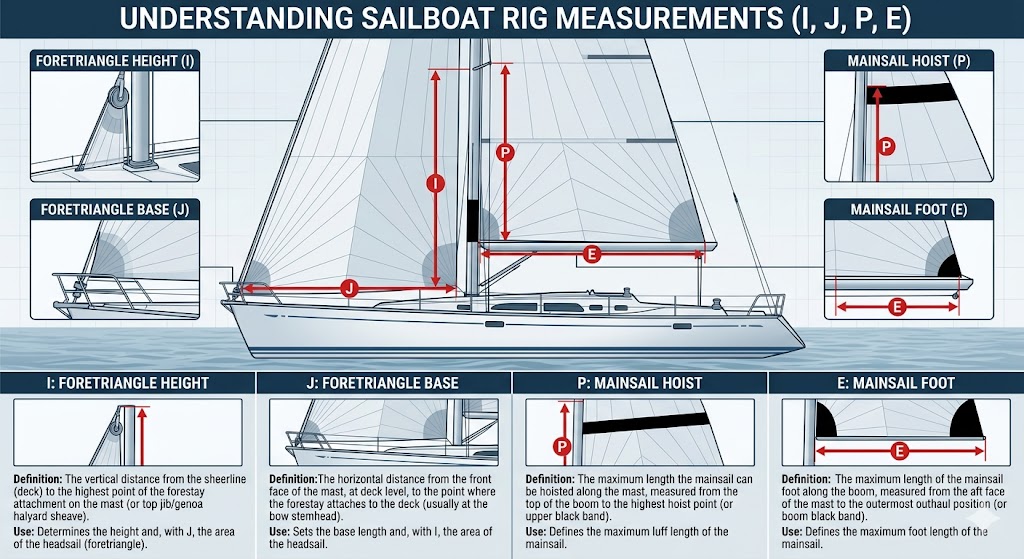
Rig Dimensions
I (Foretriangle Height) 40.50 ft / 12.34 m
J (Foretriangle Base) 13.25 ft / 4.04 m
P (Mainsail Luff) 34.00 ft / 10.36 m
E (Mainsail Foot) 12.50 ft / 3.81 m
SA Fore 268.31 ft² / 24.93 m²
SA Main 212.50 ft² / 19.74 m²
SA Total (100%) 480.81 ft² / 44.67 m²
Est. Forestay Length 42.61 ft / 12.99 m
Engine & Accommodations
Engine Make Universal
Engine Model Atomic 4
Engine Type Gas
Fuel Capacity 25 gals / 95 L
Water Capacity 40 gals / 151 L
How It Compares

vs. Ericson 34, Hunter 34, Tartan 34 2

This boat Similar boats
Dimensions
LOA
Bristol 34 ★
34.3 ft
Ericson 34
34.1 ft
Hunter 34
34.4 ft
Tartan 34 2
34.4 ft
LWL
Bristol 34 ★
26.0 ft
Ericson 34
28.9 ft
Hunter 34
28.3 ft
Tartan 34 2
28.8 ft
Beam
Bristol 34 ★
10.5 ft
Ericson 34
10.8 ft
Hunter 34
11.6 ft
Tartan 34 2
11.0 ft
Displacement
Bristol 34 ★
11 lbs
Ericson 34
10 lbs
Hunter 34
11 lbs
Tartan 34 2
11 lbs
Ballast
Bristol 34 ★
5 lbs
Ericson 34
5 lbs
Hunter 34
5 lbs
Tartan 34 2
4 lbs
Sail Area
Bristol 34 ★
481 sq ft
Ericson 34
494 sq ft
Hunter 34
567 sq ft
Tartan 34 2
538 sq ft
Performance
PHRF Rating (lower = faster)
Bristol 34 ★
210 s/nm
Ericson 34
159 s/nm
Hunter 34
159 s/nm
Tartan 34 2
174 s/nm
SA / Displacement (higher = more powerful)
Bristol 34 ★
15.2
Ericson 34
17.1
Hunter 34
17.5
Tartan 34 2
17.5
Ballast / Disp (higher = stiffer)
Bristol 34 ★
48.7 %
Ericson 34
Hunter 34
42.3 %
Tartan 34 2
40.0 %
Comfort Ratio (higher = more comfortable offshore)
Bristol 34 ★
27.2
Ericson 34
21.5
Hunter 34
23.1
Tartan 34 2
23.0
Capsize Screening (lower = safer)
Bristol 34 ★
1.86
Ericson 34
2.00
Hunter 34
2.04
Tartan 34 2
1.97
Displacement / Length (lower = lighter)
Bristol 34 ★
292
Ericson 34
Hunter 34
234
Tartan 34 2
204
Hull Speed
Bristol 34 ★
6.8 kts
Ericson 34
7.2 kts
Hunter 34
7.1 kts
Tartan 34 2
7.2 kts
Speed Number (higher = faster)
Bristol 34 ★
1.7
Ericson 34
2.9
Hunter 34
Tartan 34 2
2.7
Find a Bristol 34 For Sale