Back to Search
Bermuda 40 1 Hinckley
Designer: William Tripp, Jr.  ·  Builder: Henry R. Hinckley & Co. (Usa)  ·  First built: 1959
+ Add to Compare
Videos
About the Bermuda 40 1 Hinckley

Designed by William Tripp Jr. and built by the prestigious Henry R. Hinckley & Company from 1959 to 1991, this classic masthead yawl represents the golden age of American fiberglass yacht construction. With 203 hulls produced over three decades, the Bermuda 40 established itself as a quintessential New England cruiser, embodying Hinckley's renowned commitment to quality and craftsmanship. At 40.75 feet overall with a moderate 19,000-pound displacement, this yacht strikes an excellent balance between comfort and performance. The traditional keel/centerboard configuration provides both shallow-water access and impressive windward ability, while the 648 square feet of sail area delivers spirited performance in varied conditions. Her comfortable 34.8 comfort ratio and reassuring 1.76 capsize screening value make her well-suited for extended coastal cruising and offshore passages. The masthead yawl rig offers exceptional versatility, allowing for easy sail handling and balanced helm characteristics that cruising sailors particularly appreciate. Her 11.75-foot beam provides generous interior volume without sacrificing seaworthiness. Built to Hinckley's exacting standards, these yachts are known for their longevity, classic lines, and ability to maintain their value. The Bermuda 40 remains highly sought after by discerning sailors seeking a proven bluewater cruiser with timeless appeal.

Core Dimensions
LOA (Length Overall) 40.75 ft / 12.42 m
LWL (Waterline Length) 27.83 ft / 8.48 m
Beam 11.75 ft / 3.58 m
Max Draft 8.60 ft / 2.62 m
Min Draft 4.30 ft / 1.31 m
Displacement 19,000.00 lb / 8,618 kg
Ballast 6,500.00 lb / 2,948 kg
Ballast Type Lead
Sail Area (Reported) 648.00 ft² / 60.20 m²
Design & Construction
Hull Type Keel/Cbrd.
Rigging Type Masthead Yawl
Construction FG
Designer William Tripp, Jr.
Builder Henry R. Hinckley & Co. (USA)
First Built 1959
Last Built 1991
Number Built 203
Owner Reviews

No owner reviews yet — be the first to share your experience with this boat.

Known Issues & What to Watch For
High Keel
The centerboard trunk on keel/centerboard models is prone to weeping and slow leaks at the trunk-to-hull joint, particularly in older hulls where the original layup has stressed over decades of board cycling. Inspect the bilge area around the trunk base carefully for staining or soft laminate.
Medium Keel
The centerboard pennant and its associated hardware (sheave, pin, and pendant attachment point) are subject to significant wear and corrosion. Failure of the pennant can leave the board stuck down or lost entirely; these components are often deferred in maintenance.
High Hull/Deck
Early Hinckley Bermuda 40s used a balsa-cored deck in sections; the balsa core around deck hardware is prone to water saturation when fastener bedding fails, leading to soft spots and delamination particularly around winch bases, chainplates, and stanchion bases.
pre-1975 models
Medium Hull/Deck
The teak decking fitted on many hulls traps moisture between the teak and the underlying fiberglass, accelerating core saturation. Seam compound drying and cracking is a chronic maintenance issue and can go unnoticed for years.
High Rigging
Chainplate attachment points on early hulls pass through the deck and are glassed to interior structure in a manner that makes inspection extremely difficult. Corrosion and fatigue cracking at the deck-level seal is a known issue, and many boats have had chainplates replaced without fully addressing the structural backing.
pre-1980 models
Medium Hull/Deck
The hull-to-deck joint on early production boats was through-bolted and bedded but not glassed on the interior. Over decades, this joint can work loose and allow water ingress; inspect for any separation or caulking failure along the toerail.
pre-1970 models
Medium Accommodations
The interior joinery, though high quality, used solid teak and teak-veneered ply that can shrink, crack, and delaminate with age, particularly in boats that have experienced repeated wetting of the bilge. Structural bulkheads bonded to the hull with fiberglass tabbing should be checked for tabbing separation.
Medium Engine
Many surviving Bermuda 40s have had multiple engine replacements over their long production run; engine beds and associated through-hull exhaust fittings should be inspected carefully for proper re-installation, as amateur repowers sometimes leave compromised structural stringers or improperly bedded fittings.
High Electrical
Boats from the 1960s and 1970s often retain portions of their original wiring, which may be undersized aluminum or early copper without tinning. Partial rewiring over the years creates mixed systems with inconsistent grounding that is a corrosion and fire risk.
pre-1980 models

Own or have surveyed a Bermuda 40 1 Hinckley? Submit a known issue
Performance Ratios
SA/Displacement Sail Area to Displacement ratio measures how much sail power a boat has relative to its weight. Higher values mean more performance and speed.
Under 14 — Heavy cruiser, slow14–18 — Cruising sailboat18–22 — Cruiser/racerOver 22 — Performance racer
14.62
Ballast/Displacement Ballast to Displacement ratio shows what percentage of the boat's total weight is ballast. Higher values generally mean better initial stability and stiffer sail carrying.
30–35% — Typical cruiser35–45% — Stiff performance boatOver 45% — Racing oriented
34.21
Displacement/Length Displacement to Length ratio measures how heavy a boat is relative to its waterline length. Lower values mean a lighter, faster boat.
Under 100 — Ultralight racer100–200 — Light cruiser/racer200–300 — Moderate cruiser300–400 — Heavy cruiserOver 400 — Very heavy
393.52
Comfort Ratio Ted Brewer's Comfort Ratio predicts how comfortable a boat will feel in offshore conditions. Higher values mean a steadier, more comfortable motion in a seaway.
Under 20 — Uncomfortably rough20–30 — Acceptable coastal30–40 — Good offshore comfortOver 40 — Very comfortable offshore
34.8
Capsize Screening Formula The USHS Capsize Screening Formula estimates offshore capsize risk. Lower is safer — values under 2.0 are considered acceptable for offshore sailing.
Under 2.0 — Safe for offshore2.0–2.2 — Borderline offshoreOver 2.2 — Coastal use recommended
1.76
Hull Speed Hull Speed is the theoretical maximum speed of a displacement hull, calculated from waterline length. Most cruising sailboats reach this speed in moderate conditions. 7.07 kn
S# (Speed Number) The Speed Number (S#) is a quick performance index. Higher values indicate a faster, more powerful design relative to its size.
Under 3.0 — Slow cruiser3.0–5.0 — Average cruiser5.0–7.0 — Performance cruiserOver 7.0 — Racer
1.03
Pounds/Inch Immersion Pounds per Inch Immersion (PPI) tells you how much weight is needed to sink the boat one inch. Useful for calculating how additional gear and stores affect waterline. 1,168.42 pounds/inch
SA/Displacement (Calc) Calculated Sail Area to Displacement ratio using actual measured sail dimensions rather than reported values. More precise than the reported SA/Disp figure. 14.63
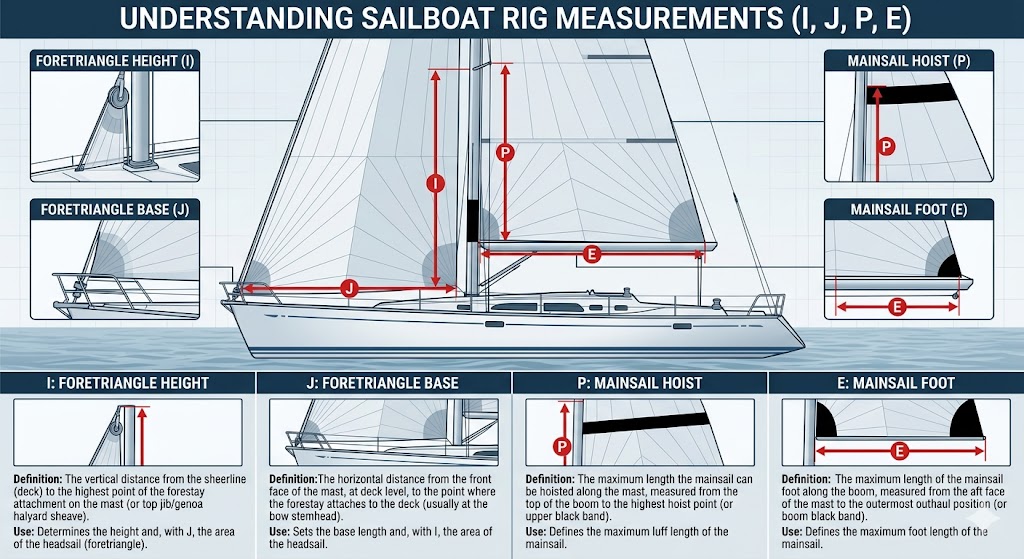
Rig Dimensions
I (Foretriangle Height) 42.50 ft / 12.95 m
J (Foretriangle Base) 15.70 ft / 4.79 m
P (Mainsail Luff) 36.60 ft / 11.16 m
E (Mainsail Foot) 17.20 ft / 5.24 m
SA Fore 333.63 ft² / 31.00 m²
SA Main 314.76 ft² / 29.24 m²
SA Total (100%) 648.39 ft² / 60.24 m²
Est. Forestay Length 45.31 ft / 13.81 m
Engine & Accommodations
Engine Make Westerbeke
Engine Model 4-107
Horsepower 40
How It Compares

vs. Rhodes 41 Pearson, Swan 411, Tartan 41

This boat Similar boats
Dimensions
LOA
Bermuda 40 1 Hinckley ★
40.8 ft
Rhodes 41 Pearson
40.8 ft
Swan 411
40.8 ft
Tartan 41
40.6 ft
LWL
Bermuda 40 1 Hinckley ★
27.8 ft
Rhodes 41 Pearson
28.0 ft
Swan 411
33.6 ft
Tartan 41
32.7 ft
Beam
Bermuda 40 1 Hinckley ★
11.8 ft
Rhodes 41 Pearson
10.3 ft
Swan 411
11.9 ft
Tartan 41
12.3 ft
Displacement
Bermuda 40 1 Hinckley ★
19 lbs
Rhodes 41 Pearson
18 lbs
Swan 411
23 lbs
Tartan 41
17 lbs
Ballast
Bermuda 40 1 Hinckley ★
6 lbs
Rhodes 41 Pearson
8 lbs
Swan 411
9 lbs
Tartan 41
9 lbs
Sail Area
Bermuda 40 1 Hinckley ★
648 sq ft
Rhodes 41 Pearson
725 sq ft
Swan 411
873 sq ft
Tartan 41
725 sq ft
Performance
PHRF Rating (lower = faster)
Bermuda 40 1 Hinckley ★
Rhodes 41 Pearson
Swan 411
87 s/nm
Tartan 41
102 s/nm
SA / Displacement (higher = more powerful)
Bermuda 40 1 Hinckley ★
14.6
Rhodes 41 Pearson
16.5
Swan 411
17.0
Tartan 41
17.1
Ballast / Disp (higher = stiffer)
Bermuda 40 1 Hinckley ★
34.2 %
Rhodes 41 Pearson
43.0 %
Swan 411
40.8 %
Tartan 41
51.5 %
Comfort Ratio (higher = more comfortable offshore)
Bermuda 40 1 Hinckley ★
34.8
Rhodes 41 Pearson
41.1
Swan 411
37.9
Tartan 41
28.0
Capsize Screening (lower = safer)
Bermuda 40 1 Hinckley ★
1.76
Rhodes 41 Pearson
1.54
Swan 411
1.66
Tartan 41
1.88
Displacement / Length (lower = lighter)
Bermuda 40 1 Hinckley ★
393
Rhodes 41 Pearson
382
Swan 411
281
Tartan 41
228
Hull Speed
Bermuda 40 1 Hinckley ★
7.1 kts
Rhodes 41 Pearson
7.1 kts
Swan 411
7.8 kts
Tartan 41
7.7 kts
Speed Number (higher = faster)
Bermuda 40 1 Hinckley ★
1.0
Rhodes 41 Pearson
1.2
Swan 411
1.9
Tartan 41
2.4
Find a Bermuda 40 1 Hinckley For Sale