Back to Search

Beneteau 393

Designer: Berret-Racoupeau  ·  Builder: Beneteau  ·  First built: 2002
+ Add to Compare
About the Beneteau 393

Designed by Berret-Racoupeau and launched by the French yard in 2002, the Oceanis 393 quickly built a reputation as one of Beneteau's more accomplished bluewater performers of its era. Over its five-year production run, 600 hulls were built at facilities in France and Marion, South Carolina — a volume that speaks to the model's wide appeal among cruising couples and club sailors stepping up to serious offshore capable yachts. The beamy masthead sloop pairs a high-aspect rig with a stable, seakindly hull form. Two keel options — a deep fin and a shoal alternative — gave buyers flexibility to match their home waters. Below, a 6'6" saloon with 130 gallons of freshwater capacity makes the 393 genuinely self-sufficient on longer passages. The cockpit is well-organized for shorthanded sailing, with traveler and sheet controls within easy reach of the helm. Strong build quality, an active owners community, and ready parts availability through the Beneteau network keep the 393 competitive on the secondhand market well over two decades after its introduction.

Core Dimensions
LOA (Length Overall) 39.3
LWL (Waterline Length) 35.08
Beam 13.0
Max Draft 6.23
Min Draft 5.09
Displacement 17152
Ballast 4650
Sail Area (Reported) 637
Headroom 6.5
Design & Construction
Hull Type Monohull
Rigging Type Sloop
Construction Fiberglass
Designer Berret-Racoupeau
Builder Beneteau
First Built 2002
Last Built 2007
Number Built 600
Owner Reviews

No owner reviews yet — be the first to share your experience with this boat.
Performance Ratios
SA/Displacement Sail Area to Displacement ratio measures how much sail power a boat has relative to its weight. Higher values mean more performance and speed.
Under 14 — Heavy cruiser, slow14–18 — Cruising sailboat18–22 — Cruiser/racerOver 22 — Performance racer
15.32
Ballast/Displacement Ballast to Displacement ratio shows what percentage of the boat's total weight is ballast. Higher values generally mean better initial stability and stiffer sail carrying.
30–35% — Typical cruiser35–45% — Stiff performance boatOver 45% — Racing oriented
27.11
Displacement/Length Displacement to Length ratio measures how heavy a boat is relative to its waterline length. Lower values mean a lighter, faster boat.
Under 100 — Ultralight racer100–200 — Light cruiser/racer200–300 — Moderate cruiser300–400 — Heavy cruiserOver 400 — Very heavy
177.37
Comfort Ratio Ted Brewer's Comfort Ratio predicts how comfortable a boat will feel in offshore conditions. Higher values mean a steadier, more comfortable motion in a seaway.
Under 20 — Uncomfortably rough20–30 — Acceptable coastal30–40 — Good offshore comfortOver 40 — Very comfortable offshore
23.77
Capsize Screening Formula The USHS Capsize Screening Formula estimates offshore capsize risk. Lower is safer — values under 2.0 are considered acceptable for offshore sailing.
Under 2.0 — Safe for offshore2.0–2.2 — Borderline offshoreOver 2.2 — Coastal use recommended
2.02
Hull Speed Hull Speed is the theoretical maximum speed of a displacement hull, calculated from waterline length. Most cruising sailboats reach this speed in moderate conditions. 7.94
Pounds/Inch Immersion Pounds per Inch Immersion (PPI) tells you how much weight is needed to sink the boat one inch. Useful for calculating how additional gear and stores affect waterline. 1824.16
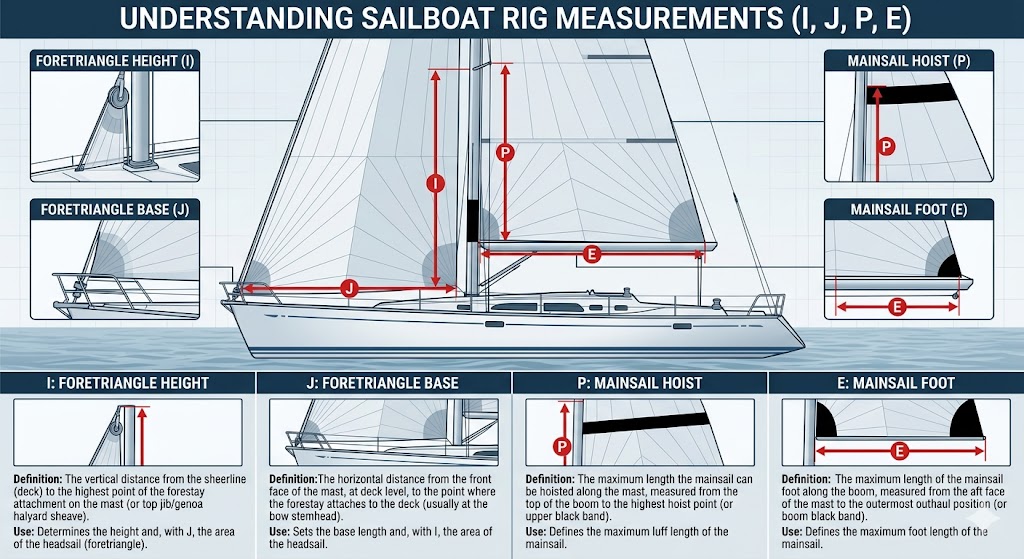
Rig Dimensions
I (Foretriangle Height) 46.08
J (Foretriangle Base) 14.5
P (Mainsail Luff) 40.33
E (Mainsail Foot) 15.08
SA Fore 334.08
SA Main 304.09
SA Total (100%) 638.17
Engine & Accommodations
Horsepower 40
Fuel Capacity 35
Water Capacity 130
Find a Beneteau 393 For Sale