Back to Search
Aristocat 30
Designer: Robin Musters / Ken Shaw  ·  Builder: Aristocat Marine Ltd. (Uk)  ·  First built: 1969
+ Add to Compare
About the Aristocat 30

Built during an era when production multihulls were gaining momentum in the recreational sailing market, this trimaran represents an interesting chapter in affordable multihull design. The Aristocat 30 emerged as part of the broader movement to bring catamaran and trimaran sailing to budget-conscious sailors seeking the performance advantages of multiple hulls. While detailed specifications remain elusive, the design appears to follow the classic trimaran configuration with a central hull flanked by smaller outrigger floats, providing the stability and speed potential that draws sailors to multihull designs. The boat's proportions suggest it was intended primarily for coastal cruising and daysailing, offering the thrilling sailing characteristics that trimarans are known for—quick acceleration, reduced heeling, and impressive light-air performance. Like many boats from this period of multihull development, the Aristocat 30 likely represents a compromise between performance and practicality, making trimaran sailing accessible to sailors transitioning from monohulls. The design would appeal to those seeking a departure from conventional sailing without the complexity of larger offshore multihulls, making it suitable for sailors interested in exploring the unique characteristics of three-hull sailing in protected waters.

Core Dimensions
LOA (Length Overall) 30.50 ft / 9.30 m
LWL (Waterline Length) 27.58 ft / 8.41 m
Beam 14.00 ft / 4.27 m
Max Draft 4.75 ft / 1.45 m
Displacement 15,000.00 lb / 6,804 kg
Design & Construction
Hull Type Catamaran Twin Cbrd.
Rigging Type Masthead Sloop
Construction FG
Designer Robin Musters / Ken Shaw
Builder Aristocat Marine Ltd. (UK)
First Built 1969
Owner Reviews

No owner reviews yet — be the first to share your experience with this boat.
Performance Ratios
Displacement/Length Displacement to Length ratio measures how heavy a boat is relative to its waterline length. Lower values mean a lighter, faster boat.
Under 100 — Ultralight racer100–200 — Light cruiser/racer200–300 — Moderate cruiser300–400 — Heavy cruiserOver 400 — Very heavy
319.2
Comfort Ratio Ted Brewer's Comfort Ratio predicts how comfortable a boat will feel in offshore conditions. Higher values mean a steadier, more comfortable motion in a seaway.
Under 20 — Uncomfortably rough20–30 — Acceptable coastal30–40 — Good offshore comfortOver 40 — Very comfortable offshore
24.06
Capsize Screening Formula The USHS Capsize Screening Formula estimates offshore capsize risk. Lower is safer — values under 2.0 are considered acceptable for offshore sailing.
Under 2.0 — Safe for offshore2.0–2.2 — Borderline offshoreOver 2.2 — Coastal use recommended
2.27
Hull Speed Hull Speed is the theoretical maximum speed of a displacement hull, calculated from waterline length. Most cruising sailboats reach this speed in moderate conditions. 7.04 kn
Pounds/Inch Immersion Pounds per Inch Immersion (PPI) tells you how much weight is needed to sink the boat one inch. Useful for calculating how additional gear and stores affect waterline. 8.27 pounds/inch
Rig Dimensions
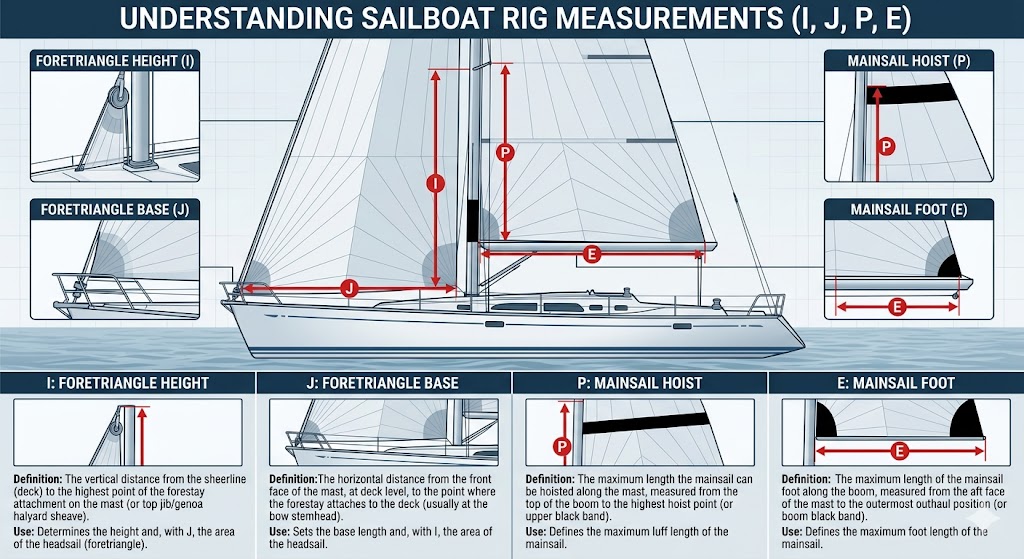
I (Foretriangle Height) 1.50 ft / 0.46 m
P (Mainsail Luff) 495.00 ft² / 45.99 m²
E (Mainsail Foot) 319.20
Find a Aristocat 30 For Sale